How to Choose an E-Invoicing ASP in the UAE: A Selection Guide for Finance Teams
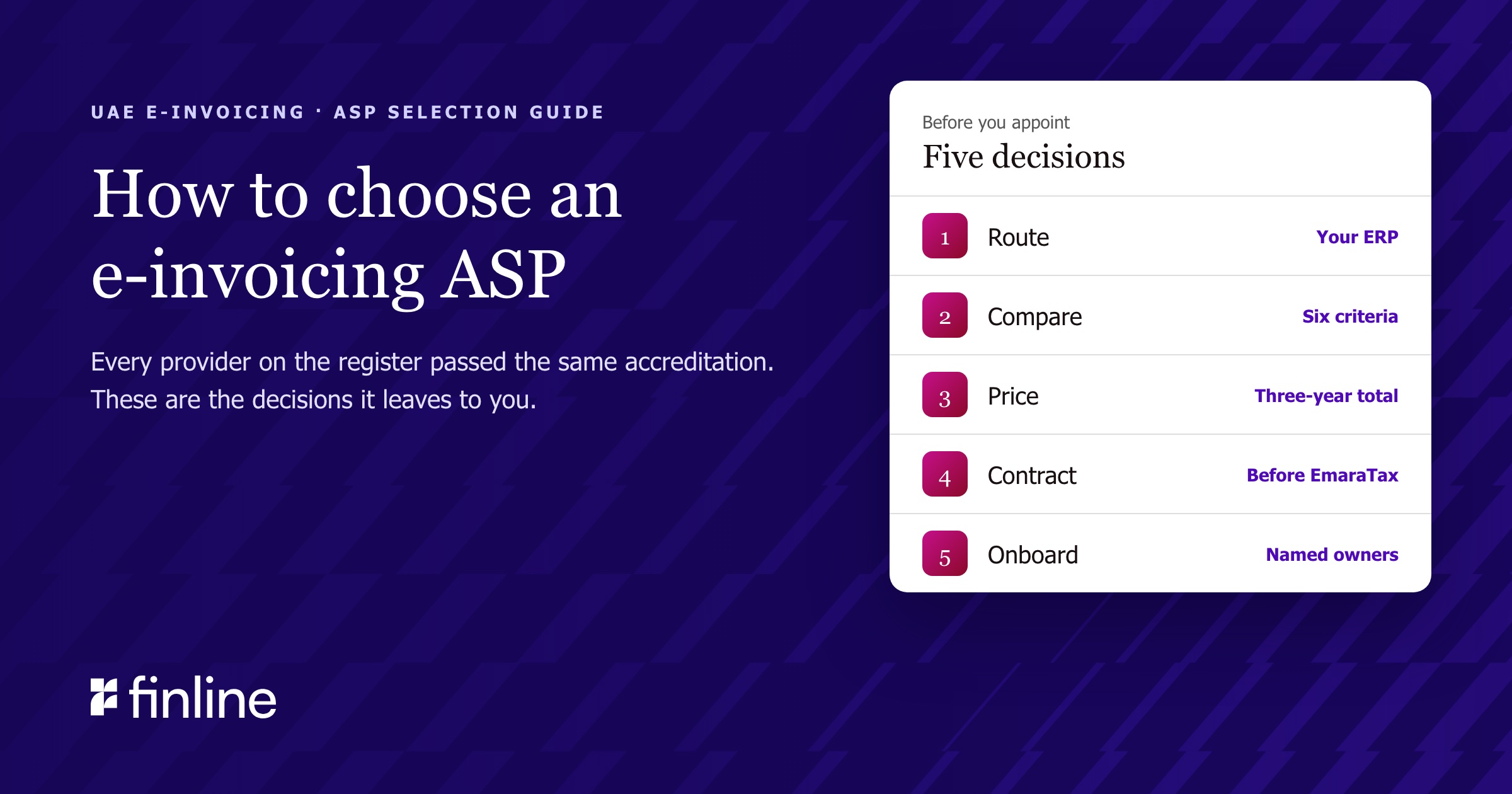
Every provider on the Ministry of Finance register has passed the same accreditation. This guide covers what sits above it: the route your ERP sets, then criteria, price, contract and switching.
Reviewed by Atul Bhargava, Chartered Accountant (ICAI). Accurate as of 15 October 2026.
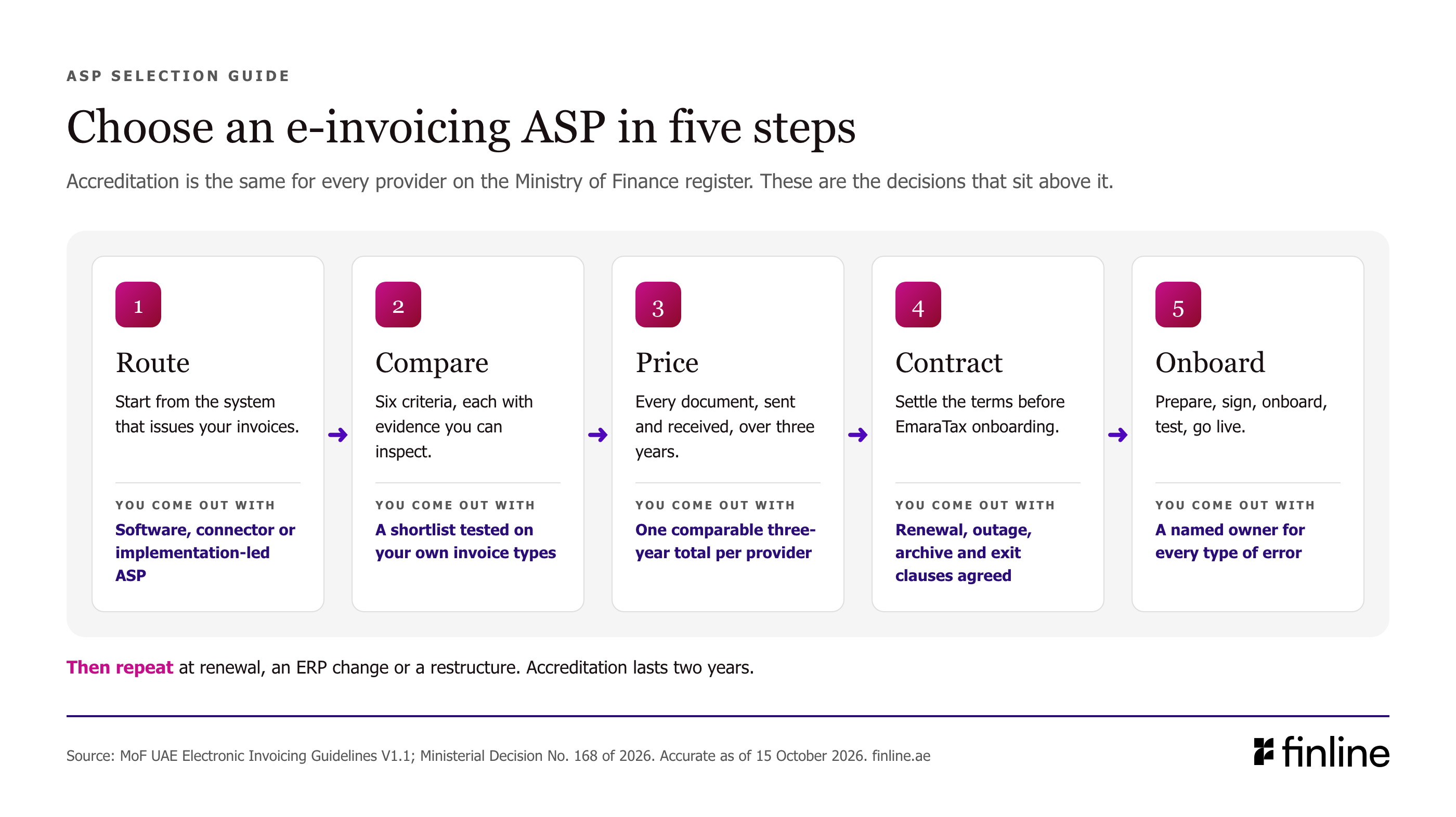
In short. Every UAE business in scope of e-invoicing sends and receives its e-invoices through one Accredited Service Provider (ASP), which it appoints itself through EmaraTax [1]. Accreditation is the same bar for every provider on the Ministry of Finance (MoF) register. It tells you who may carry your invoices, and nothing about who suits you. To choose an e-invoicing ASP, work in this order:
- Route first. If your accounting software is itself an accredited ASP, start there. If it is not, you need a connector ASP or an implementation-led one.
- Price every document, both directions. Compare three-year totals at your real volume of invoices sent and received.
- Sign the exit before you onboard. The MoF puts the contract before onboarding [1], and neither the compliance obligation nor the archive ever moves to the ASP.
Why you will choose an ASP more than once
The first appointment is driven by a deadline. E-invoicing reaches large businesses first, then the rest of the private sector, then government entities, and each phase has an appointment date that falls before its go-live [5]. Our UAE e-invoicing ASP list tracks the dates, the penalties and who is on the register.
It is rarely the last appointment. Accreditation lasts two years and has to be renewed, and an ASP that misses renewal loses its accreditation along with its links to every business it represents [2]. Businesses also change ERPs, add entities, restructure VAT groups and outgrow pricing tiers. Each of those reopens the question.
So treat it as a finance decision from the start. The ASP performs the exchange and the reporting, but in the MoF's words "the compliance obligation remains with the supplier" [1]. Records work the same way: you can contract storage to the ASP, but the legal duty to keep invoices for the retention period stays with you [1]. You are appointing an agent, and the risk stays on your side of the table.
Step 1: Choose the route your ERP sets
Most finance teams start with a shortlist of names. Start instead with the system that produces your invoices, because it narrows the field to one of three routes.
Route | Usually fits | Watch for |
|---|---|---|
Your accounting software is itself the ASP | SMEs whose books live in one accredited package | Compliance tied to your ledger; bundled pricing may depend on staying on a given plan or version |
A connector ASP integrated with your ERP | ERPs that are not accredited, groups on several systems, mid-market volumes | An integration project, and a mapping layer someone in your team has to own |
An implementation-led ASP from an advisory or consulting firm | VAT groups, free zone flows, intercompany billing, several entities | Who owns and supports the platform; project-based pricing |
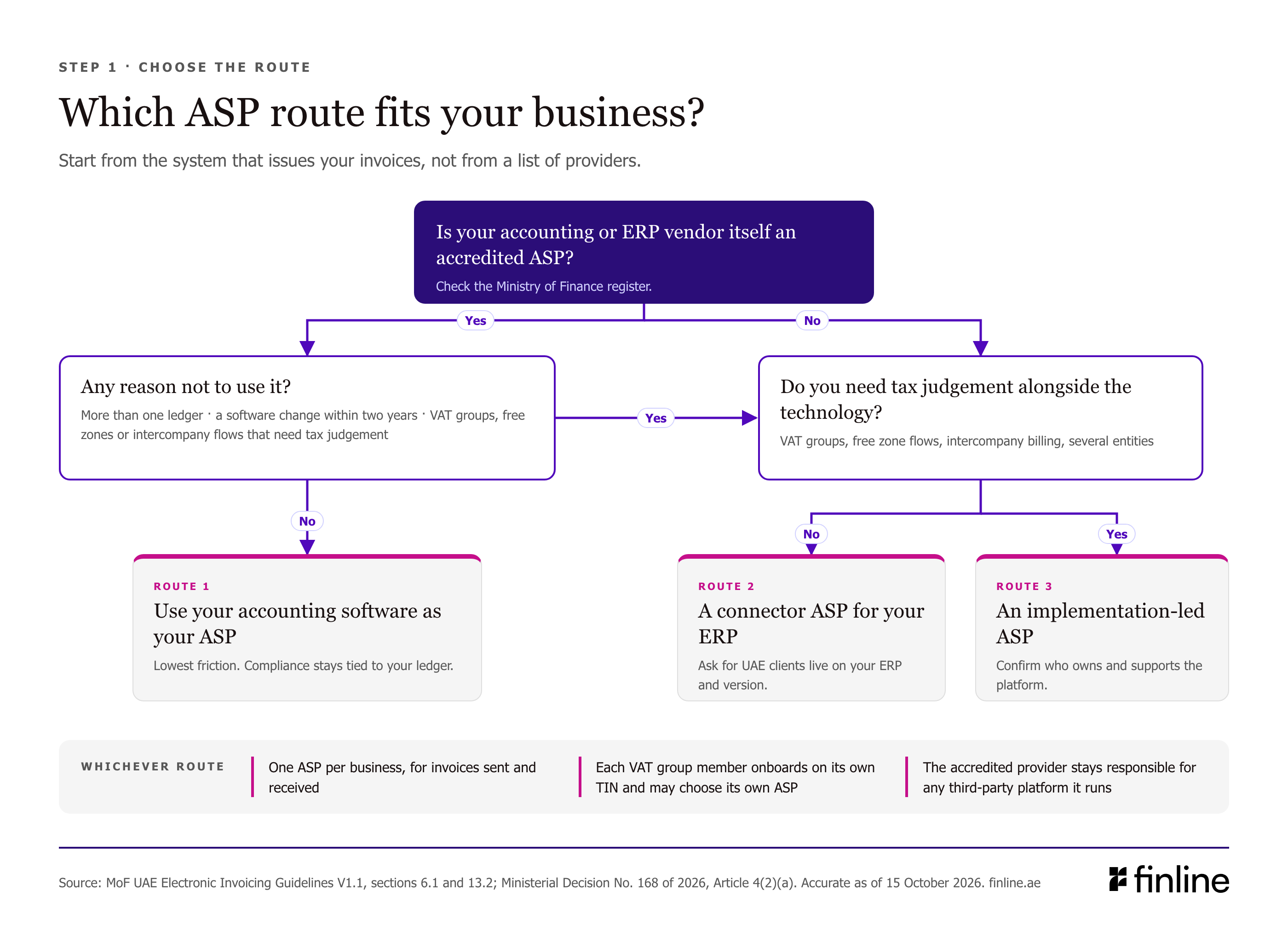
Check the register for your accounting software vendor first. At the time of writing it includes the companies behind Zoho, Tally, SAP and Wafeq, while Odoo users connect through a third-party ASP. For an SME already on an accredited package, the default answer is to use it: onboarding, the participant ID and invoice status all sit inside software the team already runs. Leave the default when you run more than one ledger, expect to change software within a couple of years, or need tax judgement on unusual flows. If your ERP vendor is not on the register, ask each connector ASP for UAE clients live on your ERP and version.
Whichever route you take, a business must appoint only one ASP for both sending and receiving invoices [1], so sales and purchases sit with the same provider. Tax groups are the exception that needs a decision: each member onboards with its own Tax Identification Number (TIN) and may use a different ASP [1]. Decide that deliberately rather than letting it follow whoever signed first.
Check, too, that the name on the register is the platform you will use. An accredited provider may run a third party's product or outsource parts of the service, provided it keeps full responsibility [2]. The MoF's own selection guidance asks whether the product is the provider's and whether support is subcontracted [3]. Ask both, and put the answers in the contract.
Step 2: Compare UAE e-invoicing ASPs on six criteria
Accreditation is a high floor. A provider must be an active Peppol-certified service provider with a product in operation for at least two years, hold ISO 22301 for business continuity and ISO/IEC 27001 for the product, encrypt data in transit and at rest, and carry professional indemnity, crime and cyber fraud insurance [2]. Every name on the register has cleared it, so none of it separates one provider from another.
What separates them is how they handle your invoices on a bad day. Compare on these six, and ask for evidence you can inspect.
Criterion | Why it matters | Evidence to request |
|---|---|---|
Integration with your ERP | Sets the effort and cost, and how often invoices fail at source | A UAE reference on the same ERP and version; a demo using your own invoice types |
Rejections and exceptions | A rejected invoice is your compliance problem, whoever caused it | The rejection screen, who is alerted, and the agreed turnaround for fixes |
Master data at onboarding | Rejections usually trace back to TRNs, buyer Peppol IDs and tax codes | Their onboarding data template, and who cleans what |
Reconciliation output | The ASP confirms when invoices reach the FTA [1]; you match that to your VAT return | A sample report of invoices transmitted, rejected and confirmed |
Continuity and change | Outages and specification updates land on your timeline | The uptime SLA, the outage process, how PINT AE updates are released, and the accreditation renewal date |
Ownership, support and data | Third-party platforms and subcontracted support change who answers | The platform owner, the support model, where data is stored, and archive access |
Rejections are where the difference shows first. Under the five-corner model, the buyer's ASP validates your invoice and, if it fails, confirms the failure back to your ASP and to the Federal Tax Authority (FTA) [1]. Schema validation rejects malformed or incomplete data, and fields outside the mandatory set are not permitted [7]. What matters is how quickly the rejection reaches the person who can fix it, inside your ERP rather than in a portal nobody opens.
Continuity is the other. If the system fails, both the issuer and the recipient must notify the FTA within two business days [4]. The MoF guidelines route that notice through the ASP [1], but the duty is yours. Find out who sends it, and how you will know it went.
Step 3: How UAE ASPs price e-invoicing
UAE ASPs price in four broad ways. Each is the cheapest option for some businesses and an expensive one for others.
Model | Suits | Watch for |
|---|---|---|
Included in your accounting subscription | Small issuers already on an accredited package | Caps, plan requirements, and what happens when you outgrow the plan |
Accounting plan plus prepaid transaction packs | Predictable, moderate volumes | Whether received invoices draw down the pack |
Volume subscription plus an onboarding or integration fee | Mid-market volumes on a connected ERP | Tier jumps, and setup fees quoted apart from the subscription |
Custom or project quote | Groups, several entities, complex flows | Scope creep, and support costs after go-live |
Because one ASP carries both your sales and your purchases [1], the volume that matters is every document in both directions: invoices sent, invoices received and credit notes. Few providers publish whether received invoices are charged, so ask and get the answer in writing. The other drivers are the number of entities, since each TIN onboards on its own [1], the depth of ERP integration, and whether you contract the archive to the ASP.
Every accredited provider commits to 100 free e-invoice exchange and reporting services a year for each end user, counted from the date the agreement is signed [2], and the MoF recommends writing that into the contract [3]. It covers a very small issuer and is a rounding error at volume. Ask how it is applied to your account.
Then ask each shortlisted ASP for one number: the total over three years at your actual volume, sent and received, including the tier you will cross as you grow. The Ministry puts the potential saving in invoice processing cost at up to 66%, based on other countries' experience [6]. How much of that you see depends less on the fee than on how far the ASP's data reaches into your payables and your VAT return.
Step 4: Settle the ASP contract before you onboard
The MoF sequence is explicit: select the ASP and finalise all contractual obligations, then onboard through EmaraTax [1]. You have the most room to negotiate before you onboard, so these terms belong in the first draft.
- Accreditation status. A warranty that the provider is accredited and will apply for renewal on time, which the law sets at 70 business days before expiry [2]. Providers must tell clients of a termination within five business days [2]; your contract should let you leave without penalty when that happens.
- Platform and subcontractors. The platform owner and any support subcontractor named, with the provider answerable for both, as the law already requires [2].
- Outage notification. Who notifies the FTA of a system failure within the two business days allowed [4], and how you receive a copy.
- Changes to your data. A defined channel for the written notice you owe your ASP within five business days of the FTA confirming a change to your registered details [4].
- Archive and exit. The archive format, how long the ASP keeps it, your access after the contract ends, and offboarding support in EmaraTax. Your retention duty outlives the contract [1].
- Price. Charges for received invoices, tier thresholds, annual increases and the 100 free services, all in writing.
Step 5: ASP onboarding, from signed contract to go-live
The MoF sets out the sequence [1]. In practice it runs like this:
- Prepare. Confirm your EmaraTax details are current, identify the changes your ERP needs, and clean master data: your own TRN and tax codes, and your buyers' Peppol participant IDs, which the supplier is responsible for collecting [1][8].
- Sign. Finalise the contract with the chosen ASP.
- Onboard on EmaraTax. The account administrator opens the E-Invoicing tile, selects the ASP and is redirected to its portal to finish [1]. The ASP issues your Peppol participant identifier: 0235 followed by the first ten digits of your TRN [1].
- Integrate and test. Agree how invoice data moves from your ERP to the ASP, then test end to end: sending, delivery, confirmations, received supplier invoices and tax data reporting [1].
- Go live with a governance model. Agree who watches transmissions and who fixes which errors, by when [1], and give each a named owner rather than a shared inbox.
Outbound. Your ERP sends invoice data to your ASP, which validates it against PINT AE, the UAE's Peppol invoice specification, and sends it over the Peppol network to your customer's ASP. Tax data goes to the FTA, and the status comes back to you: delivered, or rejected with a reason.
Inbound. A supplier's invoice arrives at your ASP over Peppol, is validated, converted into the format your ERP or payables system expects, and reported to the FTA on your side. Accounts payable receives structured data it can post, where it used to receive a PDF to key in.
Testing is where configuration errors surface. VAT has to be reported at line level in AED whatever the invoice currency, and a single credit note may adjust several earlier invoices, which many ERPs are not set up to produce [8]. Advance payments must link to the final invoice through dedicated reference fields [7].
There is no official onboarding duration, and vendor estimates run from days to months depending on the ERP. Work back from your go-live date and give most of the time to testing. The preparation in step 1 is your own work and can start before you sign anything. The same supplier and customer records also carry the checks behind FTA Decision 13 supplier verification, so clean them once. That preparation is where our e-invoicing work usually starts.
When to change your e-invoicing ASP
Some switches are forced. If your ASP's accreditation is not renewed or is terminated, its links to your business are revoked [2], and you will need another provider quickly. Others are chosen: persistent rejections, an ERP migration on the software-as-ASP route, a restructure, or a renewal price you will not pay.
Changes after go-live run through the reverification and offboarding processes in EmaraTax [1]. At the time of writing the MoF has not published a step-by-step switching procedure. Because a business may have only one ASP [1], the handover is a single cut-over, so plan it with both providers before you unlink the first: confirm how your participant ID is re-registered, fix the date invoices stop flowing through one and start through the other, and export your archive before you leave.
Every provider on the register can carry a compliant invoice. Pick the one whose contract you would still sign if you had to leave it in two years.

Sources
1. UAE Electronic Invoicing Guidelines V1.1: UAE Ministry of Finance (1 June 2026). https://mof.gov.ae/wp-content/uploads/2026/06/UAE-Electronic-Invoicing-Guidelines_V-1.1-01June2026.pdf
2. Ministerial Decision No. 168 of 2026 on the Eligibility Criteria and Accreditation Procedure for Service Providers under the Electronic Invoicing System: UAE Ministry of Finance (effective 1 October 2026). https://mof.gov.ae/wp-content/uploads/2026/10/Ministerial-Decision-No-168-of-2026-on-Eligibility-criteria-and-Accreditation-Procedure-EN-FINAL.pdf
3. Considerations for Selecting an Accredited Service Provider V1.0: UAE Ministry of Finance (23 February 2026). https://mof.gov.ae/wp-content/uploads/2026/02/Considerations-for-selecting-an-Accredited-Service-Provider_V-1.0-23Feb2024.pdf
4. Ministerial Decision No. 243 of 2025 on the Electronic Invoicing System: UAE Ministry of Finance (2025). https://mof.gov.ae/wp-content/uploads/2025/09/Ministerial-Decision-no.-243-of-2025-on-the-Electronic-Invoicing-System.pdf
5. Ministerial Decision No. 244 of 2025 on the Implementation of the Electronic Invoicing System, as amended: UAE Ministry of Finance (2025). https://mof.gov.ae/wp-content/uploads/2025/09/Ministerial-Decision-No.-244-of-2025-on-the-Implementation-of-the-Electronic-Invoicing-System.pdf
6. eInvoicing: UAE Ministry of Finance (accessed 14 October 2026). https://mof.gov.ae/en/about-us/initiatives/einvoicing/
7. UAE e-Invoicing Penalties Are Now Confirmed, Is Your Business Actually Ready?: RSM UAE (24 August 2026). https://www.rsm.global/uae/node/272
8. UAE Electronic Invoicing: Ministry of Finance issues detailed implementation guidelines: KPMG Lower Gulf (2026). https://kpmg.com/ae/en/insights/tax-insights/uae-electronic-invoicing-ministry-of-finance-issues-detailed-implementation-guidelines.html
Choosing an ASP, or reconsidering one?
A senior finance specialist will map your ERP, entities and invoice volumes to a route and a shortlist, and review the contract before you onboard.
Frequently asked questions
UAE e-invoicing requires businesses to issue structured XML invoices via the Peppol network through an Accredited Service Provider (ASP), with mandatory go-live from January 2027 for large businesses and July 2027 for SMEs. This is structured data exchange, not digitised PDFs.
The timeline:
- Pilot programme: July 2026 (voluntary participation for selected businesses)
- Phase 1 (standalone revenue of AED 50 million or more, assessed per entity or trade licence, not consolidated): appoint an ASP by 30 October 2026, extended from 31 July 2026, go live by 1 January 2027
- Phase 2 (revenue < AED 50 million): appoint an ASP by 31 March 2027, go live by 1 July 2027
- Phase 3 (UAE government entities): go live by 1 October 2027
The revenue threshold is based on standalone IFRS financial statements for each entity or trade licence, not consolidated figures. B2C transactions are excluded from the mandate until further notice.
The legal basis is Ministerial Decision 243 and Ministerial Decision 244 of 2025, with detailed guidelines published by the FTA in February 2026.
See also: Does e-invoicing apply to my business?
Accurate as of 24 August 2026. Source: UAE Ministry of Finance, Ministerial Decisions 243 and 244 of 2025.
An Accredited Service Provider is a certified intermediary that validates, formats, and transmits your e-invoices to trading partners and the FTA through the UAE's Peppol-based network. In the five-corner model the UAE has adopted, your ASP sits between your business and your buyer's ASP, with both ASPs simultaneously reporting invoice data to the FTA.
You must appoint an ASP well ahead of go-live. The appointment deadline is 30 October 2026 for Phase 1 and 31 March 2027 for Phase 2; go-live follows on 1 January 2027 and 1 July 2027. The Ministry of Finance publishes and maintains the list of Accredited Service Providers, and our breakdown of every pre-approved UAE e-invoicing ASP sets out what each one actually does.
We are not an ASP, so the evaluation criteria below are the ones we apply on your behalf.
When evaluating providers, consider: Peppol certification status, compatibility with your ERP or accounting software, pricing model (per-document fees versus flat subscription), support for the PINT AE schema, and the quality of their onboarding and testing process. ASP selection is a technical and commercial decision, so treat it with the same rigour you would apply to selecting any compliance-critical vendor.
Only if the software vendor is itself accredited and listed on the Ministry of Finance register. Several accounting and ERP vendors are, and for a business already using one of them it is usually the simplest route, because onboarding and invoice status sit inside the software. If your vendor is not on the register, you appoint a separate ASP that connects to your system.
No. A business must appoint one ASP for both the invoices it sends and the invoices it receives. Members of a VAT tax group are treated separately: each onboards with its own Tax Identification Number and may choose a different ASP.
Pricing falls into four broad models: e-invoicing included in an accounting subscription, prepaid transaction packs on top of an accounting plan, a volume-based subscription with a one-time onboarding or integration fee, and custom project quotes. Every accredited provider also commits to 100 free e-invoice exchange and reporting services a year per client. Compare providers on a three-year total at your real volume, counting invoices received as well as sent.
Yes. Changes run through the reverification and offboarding processes in EmaraTax. Because a business can have only one ASP at a time, plan the switch as a single cut-over with both providers, confirm how your Peppol participant ID is re-registered, and export your invoice archive before you leave. If your ASP loses its accreditation, its link to your business is revoked and you will need to appoint another.
The business. The ASP carries out the exchange and reporting, but the compliance obligation stays with the supplier. If the system fails, both the issuer and the recipient must notify the FTA within two business days, usually through the ASP, so the contract should say who sends that notice and how you receive a copy.

