UAE e-invoicing: what Ministerial Decision 197 of 2026 changes, and what it doesn't
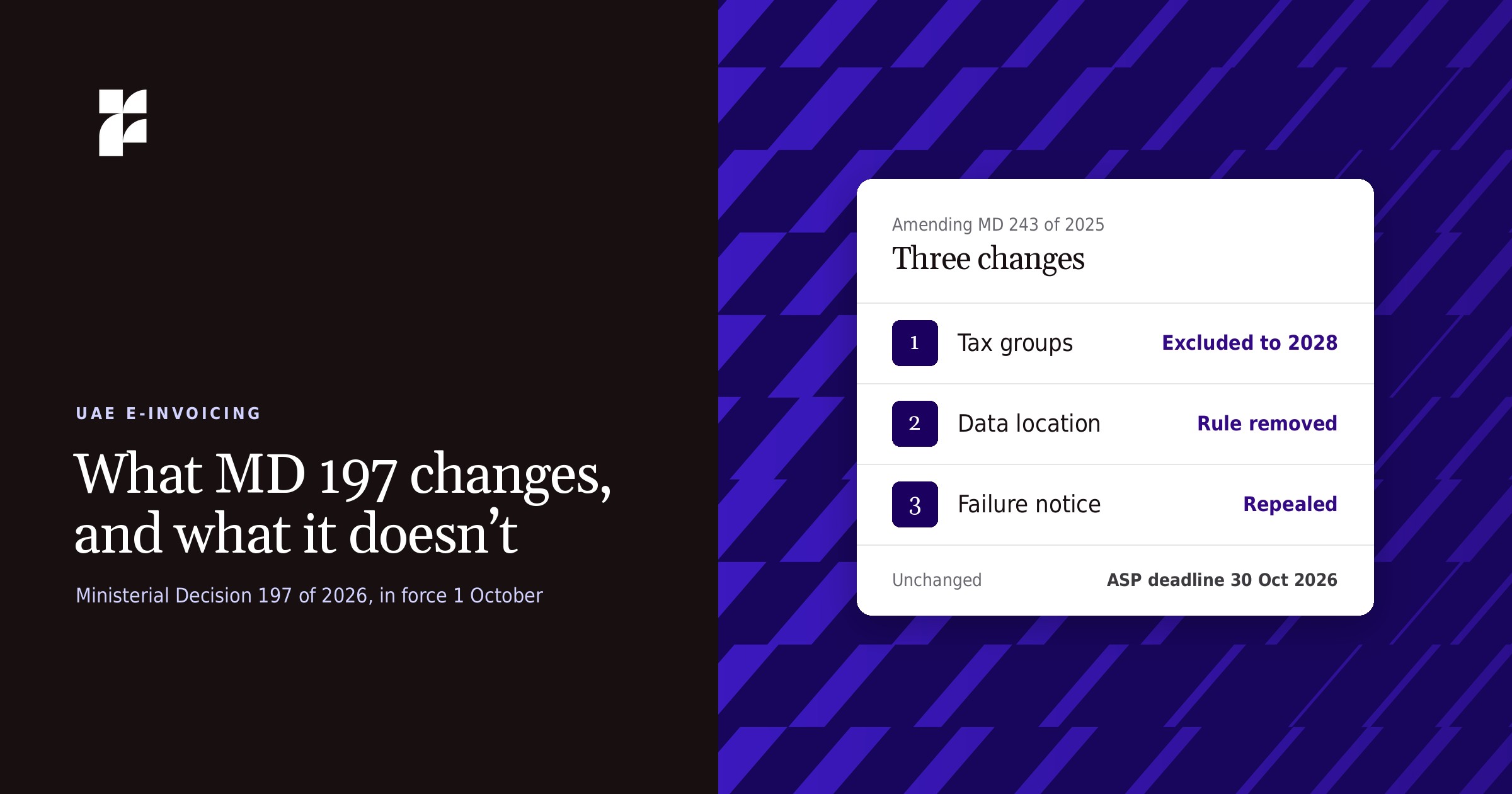
MD 197 of 2026 excludes VAT group transactions until 2028, drops the UAE data-storage location rule and the system-failure notice. Phase deadlines are unchanged.
Reviewed by Atul Bhargava, Chartered Accountant, former VP Finance at DAMAC. Accurate as of 21 October 2026.
In short. The Ministry of Finance has amended the UAE e-invoicing requirements through Ministerial Decision No. 197 of 2026, in force since 1 October 2026 [1][2]. Three changes matter most. Transactions between members of the same VAT group are excluded from e-invoicing until 31 December 2028. E-invoice records no longer have to be stored in the UAE, provided they can be produced to the Federal Tax Authority (FTA) on request. Businesses also no longer have to notify the FTA when the system fails. The deadlines have not moved: businesses with revenue of AED 50 million or more must still appoint an Accredited Service Provider (ASP) by 30 October 2026 [5][6].
What the amendment is
The decision is dated 28 September, took effect on 1 October and was announced on 19 October. For now it is published in Arabic only [1][2]. It amends the 2025 decision that sets out who is in the e-invoicing system and what they must do. The phase dates sit in a separate decision, which has not changed [3][5].
The Ministry's e-invoicing Guidelines, updated in June 2026, had anticipated some of this. They treated the storage rule as a question of whether records can be accessed, wherever they are held. They had also given VAT groups extra time to comply. The amendment goes further on VAT groups and takes their internal transactions out of scope altogether for two years [2][4].
VAT groups: two years outside the system
Under the Guidelines, transactions between members of a VAT group were in scope, with an extra 24 months to comply. The amendment now excludes them from 1 January 2027 to 31 December 2028. During that period, invoices between group members do not need to be exchanged or reported through the system [2][4].
The exclusion uses the VAT definition of a tax group, so it does not extend to corporate tax groups. It also matches how VAT already treats these supplies, which are disregarded inside a VAT group [2][7].
For a group, the following points do not change:
- Each member still joins the system separately, with its own identifier.
- Sales by any member to customers outside the group are in scope from that member's phase date.
- Unless the exclusion is extended, invoices between group members come into the system on 1 January 2029.
Recharges, management fees and cost allocations often run on different processes from customer billing, and the two years allow those flows to be mapped and automated after go-live instead of during it.
Storage: records can be held outside the UAE
The original rules required e-invoices and related data to be stored in the UAE. The amendment removes that requirement. Businesses must still keep the records for the period set by tax procedures law and be able to hand them to the FTA on request [2][3].
The retention period is the same as before: under the Guidelines, generally five years after the end of the tax period, seven years for real estate records, and longer while an audit or dispute is open [4].
For groups on a global ERP, or businesses whose provider archives data abroad, hosting outside the UAE is now consistent with the rules. The business remains responsible for producing the records when asked, so contracts with the ASP or ERP vendor should say how quickly they can be retrieved in complete, readable form [4].
You can now host e-invoice data abroad. When the FTA asks for it, the request still comes to you, not your provider.

System outages: no separate notice to the FTA
Businesses previously had to tell the FTA within two business days if the e-invoicing system failed. That requirement has been repealed [2][3].
Under the Guidelines, an ASP that suffers an outage notifies both the business and the FTA, then clears pending invoices when service resumes; the amendment leaves that role as it was. The amendment does not pause issuance deadlines during an outage, so a plan for clearing the backlog still matters [4].
Issuance window: 14 business days
Businesses that are not bound by the VAT invoicing timeline had 14 days after a transaction to issue the e-invoice. The amendment makes that 14 business days, which excludes weekends and federal public holidays. VAT-registered businesses still follow the VAT timeline [2][3].
The UAE e-invoicing deadlines and timeline are unchanged
The dates for each phase are [5][6]:
- Revenue of AED 50 million or more: appoint an ASP by 30 October 2026 and go live by 1 January 2027.
- Revenue below AED 50 million: appoint an ASP by 31 March 2027 and go live by 1 July 2027.
- Government entities: appoint an ASP by 31 March 2027 and go live by 1 October 2027.
Sales to consumers remain outside the system for now. The obligation to work through an ASP is unchanged, as are the Peppol network and the PINT-AE data standard set out in the Guidelines [3][4][5].
Check that your provider is accredited
A separate decision that took effect on the same day changes how providers are approved. From 1 October 2026, providers are accredited under Ministerial Decision No. 168 of 2026, which ends the earlier pre-approval stage. Providers that held pre-approval have 30 days from 1 October to complete accreditation, or the pre-approval is cancelled [8]. That window overlaps the 30 October appointment deadline for businesses with revenue of AED 50 million or more.
If you are appointing a provider before 30 October, confirm it is accredited, not only pre-approved. Finline's UAE e-invoicing ASP list shows the current register.
What this tells finance teams
The Ministry has followed a consistent pattern: positions appear first in the Guidelines and later become law. The relief in this amendment is aimed at implementation and leaves scope and deadlines alone. Businesses that planned against the Guidelines lose nothing, and VAT groups gain more than the Guidelines promised. When an announcement and the decision text differ, finance teams should plan to the decision text.
For businesses with revenue of AED 50 million or more, the next date is the 30 October ASP appointment. The e-invoicing timeline by phase sets out the dates that apply to each business.
Sources
1. Ministry of Finance Amends Electronic Invoicing Regulations to Ease the Burden on Businesses: Ministry of Finance (19 October 2026). https://mof.gov.ae/en/news/ministry-of-finance-amends-electronic-invoicing-regulations-to-ease-the-burden-on-businesses/
2. Ministerial Decision No. 197 of 2026 Amending Certain Provisions of Ministerial Decision No. 243 of 2025 on the Electronic Invoicing System (Arabic): Ministry of Finance (28 September 2026). https://mof.gov.ae/wp-content/uploads/2026/10/Ministerial-Decision-No.-197-of-2026-%E2%80%93-Amending-Certain-Provisions-of-Ministerial-Decision-No.-243-of-2025-on-the-Electronic-Invoicing-System_Ar.pdf
3. Ministerial Decision No. 243 of 2025 on the Electronic Invoicing System: Ministry of Finance (September 2025). https://mof.gov.ae/wp-content/uploads/2025/09/Ministerial-Decision-no.-243-of-2025-on-the-Electronic-Invoicing-System.pdf
4. UAE Electronic Invoicing Guidelines, Version 1.1: Ministry of Finance (1 June 2026). https://mof.gov.ae/wp-content/uploads/2026/06/UAE-Electronic-Invoicing-Guidelines_V-1.1-01June2026.pdf
5. Ministerial Decision No. 244 of 2025 on the Implementation of the Electronic Invoicing System: Ministry of Finance (September 2025). https://mof.gov.ae/wp-content/uploads/2025/09/Ministerial-Decision-No.-244-of-2025-on-the-Implementation-of-the-Electronic-Invoicing-System.pdf
6. Ministerial Decision No. 66 of 2026 Amending Certain Provisions of Ministerial Decision No. 244 of 2025: Ministry of Finance (May 2026). https://mof.gov.ae/wp-content/uploads/2026/05/Ministerial-Resolution-No.-66-of-2026-Amending-Certain-Provisions-of-Ministerial-Resolution-No.-244-of-2025-Regarding-the-Implementation-of-the-Electronic-Invoicing-System-En-20260514.pdf
7. Tax Groups VAT Guide (VATG101): Federal Tax Authority (May 2018). https://tax.gov.ae/-/media/Files/EN/PDF/Guides/Tax-Groups-Guide.pdf
8. Ministerial Decision No. 168 of 2026 on the Eligibility Criteria and Accreditation Procedure for Service Providers (Arabic): Ministry of Finance (2026). https://mof.gov.ae/wp-content/uploads/2026/10/Ministerial-Decision-No-168-of-2026-on-Eligibility-criteria-and-Accreditation-Procedure-AR-FINAL.pdf
Check how MD 197 applies to your entities and systems
A senior finance specialist will check your VAT group invoicing and data hosting against the decision text before your phase date.
Frequently asked questions
UAE e-invoicing requires businesses to issue and receive invoices as structured data through an Accredited Service Provider (ASP), using the Peppol network and the PINT-AE data standard. It applies to business-to-business and business-to-government transactions.
- Revenue of AED 50 million or more: appoint an ASP by 30 October 2026 and go live by 1 January 2027.
- Revenue below AED 50 million: appoint an ASP by 31 March 2027 and go live by 1 July 2027.
- Government entities: appoint an ASP by 31 March 2027 and go live by 1 October 2027.
Sales to consumers are outside the system for now, and transactions between members of the same VAT group are excluded until 31 December 2028. The rules are set by Ministerial Decisions 243 and 244 of 2025, as amended, with Guidelines published by the Ministry of Finance (version 1.1, June 2026).
See also: Does e-invoicing apply to my business?
Accurate as of 21 October 2026. Source: Ministry of Finance, Ministerial Decisions 243 and 244 of 2025, as amended.
The business. The ASP carries out the exchange and reporting, but the compliance obligation stays with the supplier. Since 1 October 2026, businesses no longer notify the FTA of a system failure themselves. Under the Ministry of Finance Guidelines, an ASP that suffers an outage notifies the business and the FTA, then clears pending invoices when service resumes.
Issuance deadlines are not paused during an outage, so the contract should say how the ASP reports outages to you and how quickly it clears the backlog.
Accurate as of 21 October 2026. Source: Ministerial Decision No. 197 of 2026; Ministry of Finance e-invoicing Guidelines.
No. The amendment changes the e-invoicing requirements but leaves the phase dates as they were:
- Revenue of AED 50 million or more: appoint an Accredited Service Provider (ASP) by 30 October 2026 and go live by 1 January 2027.
- Revenue below AED 50 million: appoint an ASP by 31 March 2027 and go live by 1 July 2027.
- Government entities: appoint an ASP by 31 March 2027 and go live by 1 October 2027.
Accurate as of 21 October 2026. Source: Ministry of Finance.
Not until 2029. Transactions between members of the same VAT group are excluded from 1 January 2027 to 31 December 2028, so invoices between group members do not need to be exchanged or reported through the system during that period.
Each member still joins the system separately, and its sales to customers outside the group are in scope from its own phase date. The exclusion does not cover corporate tax groups.
Accurate as of 21 October 2026. Source: Ministerial Decision No. 197 of 2026.
Yes. The requirement to store e-invoices and related data in the UAE has been removed. Businesses must keep the records for the period set by tax procedures law and be able to hand them to the FTA on request.
The business remains responsible for producing them, so contracts with the ASP or ERP vendor should say how quickly records can be retrieved.
Accurate as of 21 October 2026. Source: Ministerial Decision No. 197 of 2026; Ministry of Finance e-invoicing Guidelines.

