UAE E-Invoicing Penalties: Every Fine Under Cabinet Decision 173 and the Process Behind It
Every UAE e-invoicing fine under Cabinet Decision 173 of 2026, what changed from Decision 106, who is exempt, and the invoicing processes that trigger each penalty.
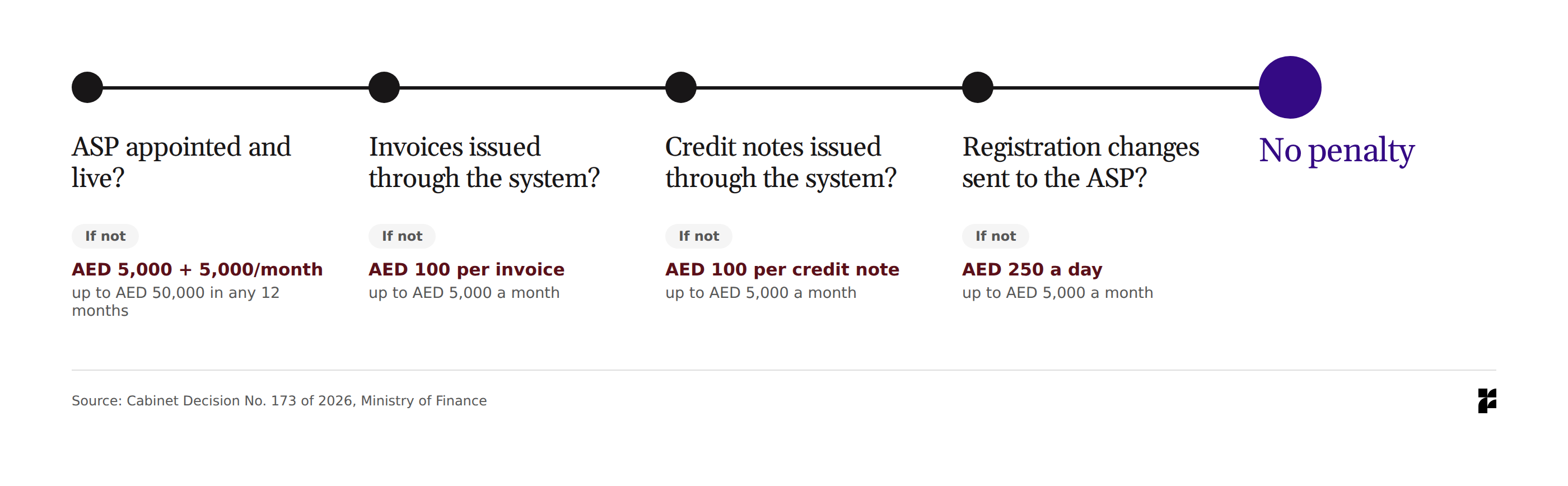
In short. Cabinet Decision No. 173 of 2026 sets the UAE e-invoicing penalties and replaces Cabinet Decision No. 106 of 2025. Not implementing the system, including not appointing an Accredited Service Provider (ASP), costs AED 5,000 and then AED 5,000 for each month it continues, up to AED 50,000 in any 12 consecutive months. Each e-invoice or credit note not issued through the system costs AED 100, capped at AED 5,000 a month for each, and a data change not passed to the ASP costs AED 250 a day, capped at AED 5,000 a month. The fine for not reporting a system failure has gone [1][2][3].
The UAE e-invoicing penalties at a glance
The Ministry of Finance announced the decision on 30 October 2026. It said the revision follows feedback from businesses and takes a more proportionate approach. The schedule now has four rows. Each is set against the decision it replaces [1][2][3]:
What goes wrong | Penalty now (Cabinet Decision 173 of 2026) | Under the previous decision |
|---|---|---|
The business does not implement the system, including not appointing an ASP (issuer or recipient) | AED 5,000, then AED 5,000 for each month or part of a month it continues, up to AED 50,000 in any 12 consecutive months | AED 5,000 for each month or part of a month, no cap, issuers only |
A recipient that has implemented the system stops meeting its recipient obligations | Same fine, sharing the same cap | No equivalent |
An e-invoice is not issued and transmitted through the system | AED 100 per invoice, up to AED 5,000 per calendar month | Amount unchanged; the wording no longer refers to the Minister's timeline |
An e-credit note is not issued and transmitted through the system | AED 100 per credit note, up to AED 5,000 per calendar month | Amount unchanged; the wording no longer refers to the Minister's timeline |
A change to FTA-registered data is not notified to the ASP | AED 250 per day or part of a day, up to AED 5,000 per calendar month | AED 1,000 per day, no cap |
A system failure is not notified to the FTA | Removed | AED 1,000 per day, issuers and recipients |
Some reporting still quotes AED 1,000 a day for the data-change fine. The decision text sets it at AED 250 a day with a monthly cap [1].
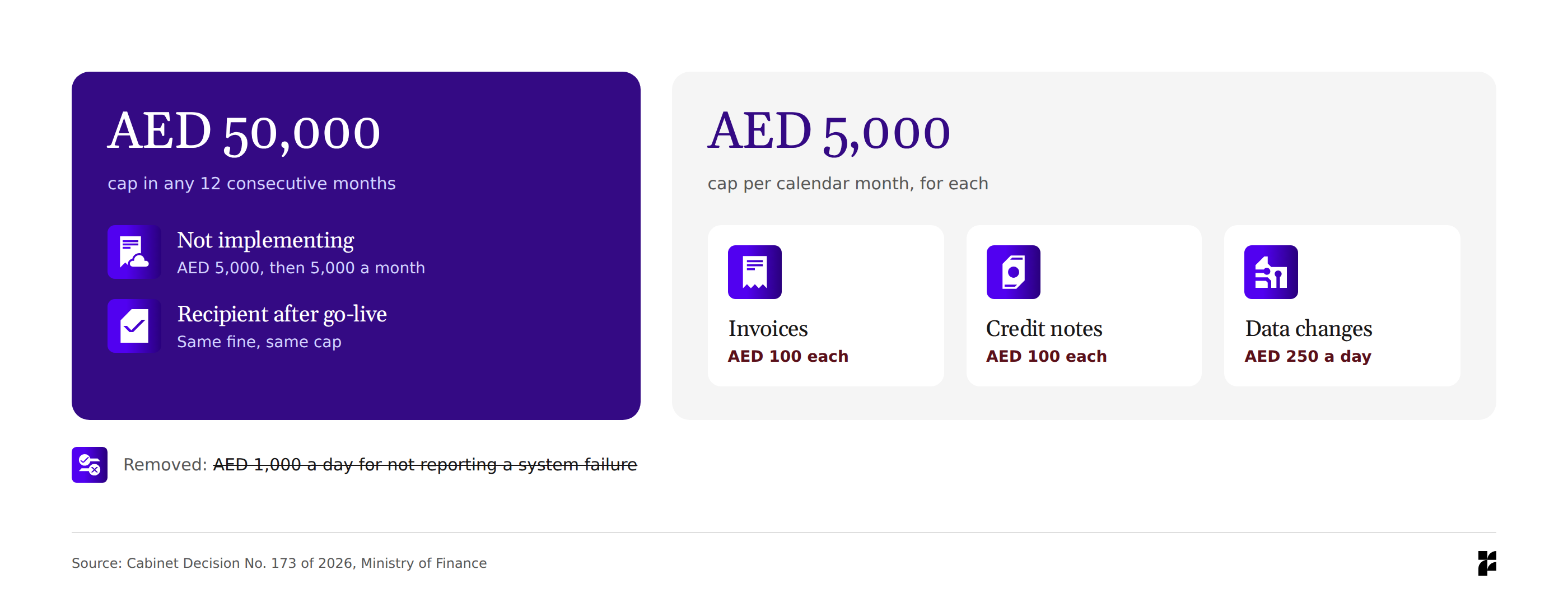
Not implementing the system: up to AED 50,000 in any 12 consecutive months
The largest fine covers a business that has not joined the system as the phase rules require. Not appointing an ASP is named in the row itself. It now applies to recipients as well as issuers, and it has a second limb: a recipient that went live and then stopped meeting its recipient obligations is fined on the same scale. The AED 50,000 cap across any 12 consecutive months applies to this row only [1].
The phase dates have not changed [5][6][7]:
- Revenue of AED 50 million or more: appoint an ASP by 30 October 2026 (set by Ministerial Decision 66 of 2026), go live by 1 January 2027.
- Revenue below AED 50 million: appoint an ASP by 31 March 2027, go live by 1 July 2027.
- Government entities: appoint an ASP by 31 March 2027, go live by 1 October 2027.
The first appointment date has passed, and no extension has been published. A business in the first phase without an ASP is in the position this row describes, and the monthly fine continues for as long as that lasts. The practical step is to appoint a provider now that is accredited under Ministerial Decision 168 of 2026 and listed on the Ministry's Central Register, and to keep the 1 January 2027 go-live as the working deadline. Pre-approval under the old framework lapsed after a 30-day transition from 1 October 2026 [8]. Finline's UAE e-invoicing ASP list shows the current register.
Invoices and credit notes: AED 100 each
An invoice or credit note that should have gone through the system and did not costs AED 100. The cap is AED 5,000 per calendar month for invoices and a separate AED 5,000 for credit notes, so a month with failures in both can reach AED 10,000. There is no annual cap on these rows; each month starts again [1].
Credit notes are the likelier gap. Billing usually runs through one controlled flow in the ERP. Credit notes often do not: a refund agreed by customer service, a volume rebate calculated at quarter end, or a pricing correction raised by hand in a spreadsheet and posted as a journal. Each of those is a credit note that the decision expects to see in the system.
The issuing deadline sits in the e-invoicing rules, not in the penalty decision. VAT-registered businesses issue within the VAT invoicing timeline. Other businesses must issue and transmit the e-invoice or credit note within 14 business days of the transaction, a window that Ministerial Decision 197 of 2026, in force from 1 October 2026, changed from 14 days [4][7][9].
Decision 106 described these violations as failing to issue within the timeline prescribed by the Minister. Decision 173 describes them only as failing to issue and transmit through the system. The FTA has not yet said whether a late e-invoice falls under this row, so the safer course is to treat the deadline as a hard control [1][2].
Data changes your ASP needs to know about
When the details a business has registered with the FTA change, for example a new trade name or address, the business must tell its ASP in writing within five business days of the FTA confirming the change [9]. Each day of delay after that costs AED 250, up to AED 5,000 a calendar month. The previous rate was AED 1,000 a day with no ceiling. The duty applies to issuers and recipients alike [1][2].
The usual cause is organisational. Someone updates the registration in EmaraTax, often the person who handles the trade licence renewal, and nobody tells the team that maintains the ERP or the provider relationship. Invoices keep going out with the old details. The fix is a trigger in the master-data process: any change to FTA registration opens a task to update the ASP, with a named owner and a date.
Who is outside the penalties, and what the decision leaves open
Three rules narrow the exposure [1][3][4][7]:
- Businesses that issue, exchange or report e-invoices voluntarily are excepted from the decision. The exception ends on the date the business is required to implement e-invoicing; from then on the penalties apply in full.
- Where the same business acts as issuer, recipient or both for the same violation, it receives one penalty, not two.
- The fine for not notifying the FTA of a system failure is gone, because Ministerial Decision 197 of 2026, in force from 1 October 2026, removed the business's notification duty itself. Outages still get reported: the Ministry's guidelines make the ASP responsible for notifying the FTA, and the business for making sure it does. Check that your ASP contract covers this.
The text leaves some points open. The decision comes into force on the day after its publication in the Official Gazette, and the published text does not give that date. It repeals the previous decision without a transitional rule, and it says nothing about waivers or reconsideration [1]. Until the FTA issues guidance, finance teams should plan to the schedule as written.
Turning the schedule into controls
Each row in the schedule traces back to a process, and each process has an owner. Mapping them before go-live is the most direct way to avoid the fines:
Penalty | Process that triggers it | Typical owner | Control |
|---|---|---|---|
Not implementing, or not appointing an ASP | Project plan and ASP contract | Finance leader | Signed ASP contract and a go-live date tracked against the phase |
Recipient compliance after go-live | Accounts payable intake | AP lead | Supplier invoices received only through the ASP, with exceptions logged |
Invoice not issued through the system | Order to cash | Billing or AR lead | The ERP blocks invoices outside the e-invoicing flow; a daily rejection report is reviewed |
Credit note not issued through the system | Refunds, rebates and price corrections | AR lead with sales operations | All credits raised in the ERP; manual adjustments reviewed at month end |
Data change not notified to the ASP | Licence renewal and FTA registration updates | Whoever maintains EmaraTax | A change in EmaraTax triggers an ASP update within five business days of FTA confirmation |
Most of these fines will not come from a business refusing to start. They will come from a credit note raised outside the system, or a TRN change nobody passed to the provider.

Finline works with a client's existing finance team, ERP and ASP to set these controls up. The e-invoicing service covers the process mapping and go-live.
Sources
1. Cabinet Decision No. 173 of 2026 on the Violations and Administrative Penalties Resulting from Violation of the Legislation Regulating the Electronic Invoicing System: Ministry of Finance (published 30 October 2026). https://mof.gov.ae/wp-content/uploads/2026/10/Cabinet-Decision-No.-173-of-2026-On-the-Violations-and-Administrative-Penalties-Resulting-from-Violation-of-the-Legislation-Regulating-the-Electronic-Invoicing-System_En.pdf
2. Cabinet Decision No. 106 of 2025 on the Violations and Administrative Penalties Resulting from the Violations of the Legislation Regulating the Electronic Invoicing System: Ministry of Finance (November 2025). https://mof.gov.ae/wp-content/uploads/2025/12/Cabinet-Decision-Violations-and-Penalties-eInvoicing-final-version-en-8.12.25.pdf
3. MoF announces updated administrative penalties related to the UAE eInvoicing system: Ministry of Finance (30 October 2026). https://mof.gov.ae/en/news/mof-announces-updated-administrative-penalties-related-to-the-uae-einvoicing-system-to-enhance-clarity-and-support-business-compliance/
4. Ministerial Decision No. 197 of 2026 Amending Certain Provisions of Ministerial Decision No. 243 of 2025 on the Electronic Invoicing System: Ministry of Finance (28 September 2026, in force 1 October 2026). https://mof.gov.ae/wp-content/uploads/2026/10/Ministerial-Decision-No.-197-of-2026-%E2%80%93-Amending-Certain-Provisions-of-Ministerial-Decision-No.-243-of-2025-on-the-Electronic-Invoicing-System_En.pdf
5. Ministerial Decision No. 244 of 2025 on the Implementation of the Electronic Invoicing System: Ministry of Finance (September 2025). https://mof.gov.ae/wp-content/uploads/2025/09/Ministerial-Decision-No.-244-of-2025-on-the-Implementation-of-the-Electronic-Invoicing-System.pdf
6. Ministerial Decision No. 66 of 2026 Amending Certain Provisions of Ministerial Decision No. 244 of 2025: Ministry of Finance (May 2026). https://mof.gov.ae/wp-content/uploads/2026/05/Ministerial-Resolution-No.-66-of-2026-Amending-Certain-Provisions-of-Ministerial-Resolution-No.-244-of-2025-Regarding-the-Implementation-of-the-Electronic-Invoicing-System-En-20260514.pdf
7. UAE Electronic Invoicing Guidelines, Version 2.0: Ministry of Finance (26 October 2026). https://mof.gov.ae/wp-content/uploads/2026/10/UAE-Electronic-Invoicing-Guidelines_En.pdf
8. Ministerial Decision No. 168 of 2026 on the Eligibility Criteria and Accreditation Procedure for Service Providers under the Electronic Invoicing System: Ministry of Finance (in force 1 October 2026). https://mof.gov.ae/wp-content/uploads/2026/10/Ministerial-Decision-No-168-of-2026-on-Eligibility-criteria-and-Accreditation-Procedure-EN-FINAL.pdf
9. Ministerial Decision No. 243 of 2025 on the Electronic Invoicing System: Ministry of Finance (September 2025). https://mof.gov.ae/wp-content/uploads/2025/09/Ministerial-Decision-no.-243-of-2025-on-the-Electronic-Invoicing-System.pdf
Check which penalty rows your invoicing process is exposed to
A senior finance specialist will walk through your invoice, credit note and master-data flows against the new schedule before your go-live date.
Frequently asked questions
AED 5,000 for the first instance, then AED 5,000 for each month or part of a month the failure continues, up to AED 50,000 in any 12 consecutive months. The same fine applies to a business that has not implemented the e-invoicing system on time.
Each penalty has its own limit. The implementation fine is capped at AED 50,000 in any 12 consecutive months. Invoice, credit note and data-change fines are each capped at AED 5,000 per calendar month, with no annual cap.
Yes. A recipient that does not implement the system, or stops meeting its recipient obligations after go-live, faces the same fine as an issuer. Where one business is both issuer and recipient for the same violation, only one penalty applies.
No. Ministerial Decision 197 of 2026 removed the business's duty to notify the FTA of a system failure from 1 October 2026, and Cabinet Decision 173 of 2026 has no penalty for it. Outages are still reported: the Ministry's guidelines make the ASP responsible for notifying the FTA, and the business for making sure it does.
No, but only until the business's mandatory date. Businesses that issue, exchange or report e-invoices on a voluntary basis are excepted from the penalty decision. Once a business is required to implement e-invoicing under its phase, the penalties apply in full.
Cabinet Decision 173 of 2026 comes into force the day after it is published in the Official Gazette. It replaces Cabinet Decision 106 of 2025.
