Do You Need to Register for VAT in the UAE? Thresholds, the 30-Day Deadline and What Late Costs
VAT registration in the UAE turns on a rolling 12-month figure, a 30-day deadline and an effective date that usually comes first. What counts, when to apply and what late costs.

In short. VAT registration in the UAE is mandatory once a business's taxable supplies and imports exceed AED 375,000 over the previous 12 months, or are expected to in the next 30 days. The business has 30 days to apply, but registration usually takes effect from the first day of the following month. Registering late costs AED 10,000, plus the VAT due on sales since that date [1][2][3].
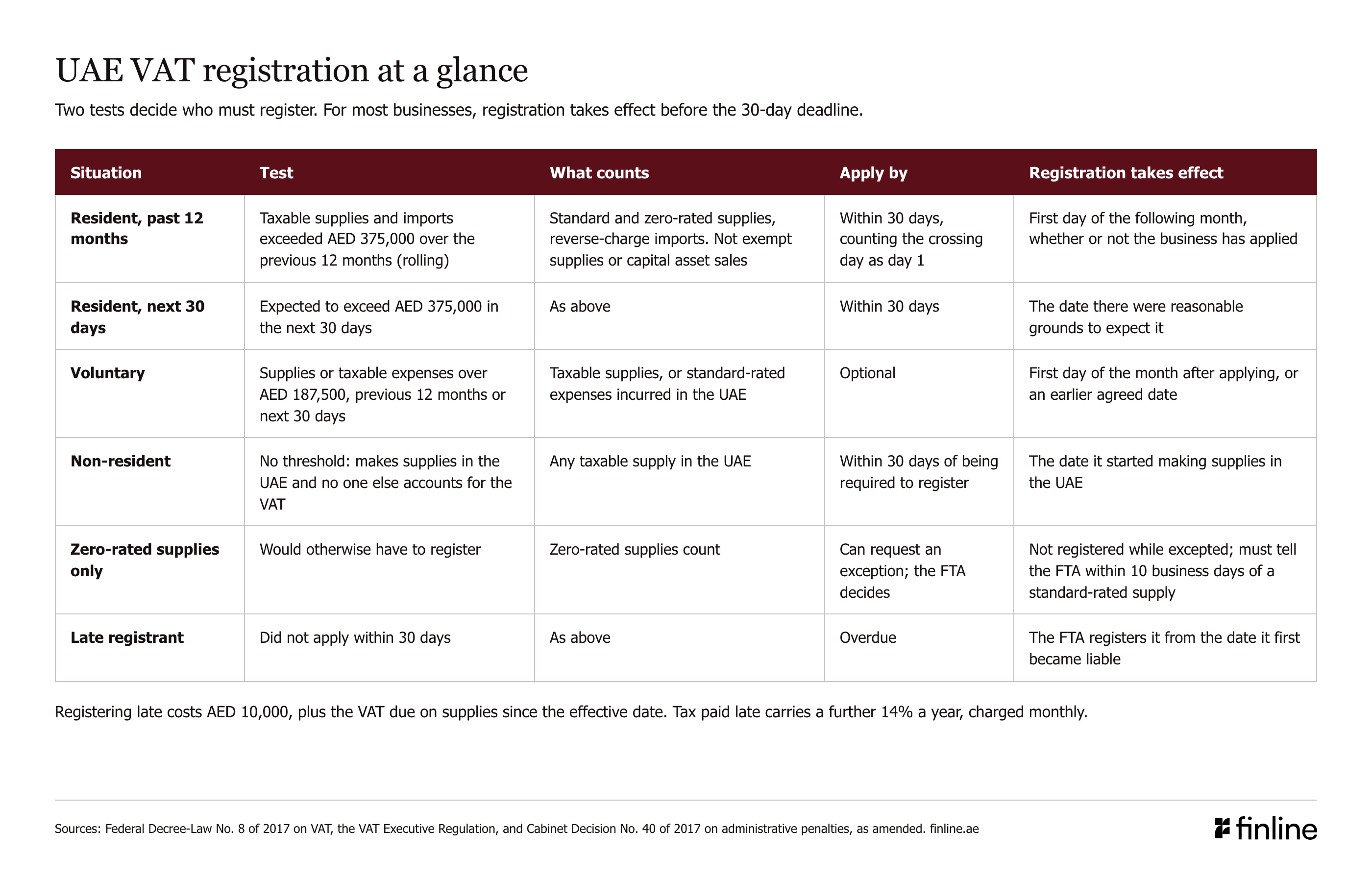
VAT registration in the UAE: who needs to register
Either of two tests is enough. Looking back, a UAE-resident business must register if its taxable supplies and imports exceeded AED 375,000 over the previous 12 months. Looking forward, it must register if they are expected to exceed AED 375,000 in the next 30 days. The law says "exceed", so exactly AED 375,000 does not trigger it [1][2].
The 12-month test is rolling. It does not follow the calendar or financial year, so a year-end check of "annual turnover" can miss the month the threshold was crossed. The FTA says businesses have to monitor their supplies and imports on an ongoing basis, because the test can be met in any month [4].
No threshold applies to a non-resident: it must register if it makes supplies in the UAE and no other person has to account for the VAT on them. Its registration takes effect from the date it started making those supplies [1][2][5].
What counts toward the AED 375,000 VAT registration threshold
The threshold counts taxable supplies rather than total revenue: zero-rated supplies are in, as are imports accounted for under the reverse charge and the taxable supplies of any business acquired. Exempt supplies do not count: residential buildings sold or leased (outside the zero-rated cases), bare land, local passenger transport and specified financial services [2].
One-off sales of capital assets are also left out. A cafe that sells its van for AED 60,000 in a year with AED 340,000 of taxable sales stays at AED 340,000. Routine stock sales do count [2][4].
A business whose supplies are all zero-rated still has to register, unless the FTA grants it an exception on request, at its discretion. An excepted business must tell the FTA within 10 business days of making a standard-rated supply or import, and then register [1][2][4].
Where associated persons have artificially split a business between them, the FTA can treat them as one for the threshold test. Related persons established in the UAE can also register as a single tax group, with every member jointly liable [1][2].
Illustrative example: rent plus consultancy. A company earns AED 300,000 a year in residential rent and AED 200,000 in consultancy fees. The rent is exempt, so only AED 200,000 counts, and registration is not mandatory on AED 500,000 of revenue. If the same owner instead split AED 450,000 of consultancy across two licences, AED 250,000 and AED 200,000, the FTA could treat them as one business for the threshold test [1][2].
Voluntary VAT registration at AED 187,500
A business below the mandatory line may register voluntarily if its taxable supplies or taxable expenses exceeded AED 187,500 over the previous 12 months, or are expected to in the next 30 days. Taxable expenses are standard-rated expenses incurred in the UAE by a UAE resident, a route the Ministry of Finance says is meant for start-ups with no turnover yet. The applicant must show a business in the UAE and an intention to make taxable supplies. Registration takes effect from the first day of the month after applying, or an earlier agreed date [1][2][6].
The FTA's reasons to opt in are recovering VAT on costs, keeping it out of prices and using the reverse charge on imports. The consultancy above qualifies at AED 200,000, but a business with exempt income recovers only part of its input VAT, so the answer needs a calculation. A voluntary registrant cannot deregister within 12 months [1][2][4].
The 30-day deadline and the date that comes first
A business must apply within 30 days of being required to register, counting the day the threshold is crossed as day 1: in the FTA's example, a business that exceeds it on 1 June applies by 30 June [1][4][7].
On the 12-month test, registration takes effect from the first day of the following month, whether or not the business has applied. On the 30-day test, it takes effect from the date there were reasonable grounds to expect the threshold to be exceeded [1][4].
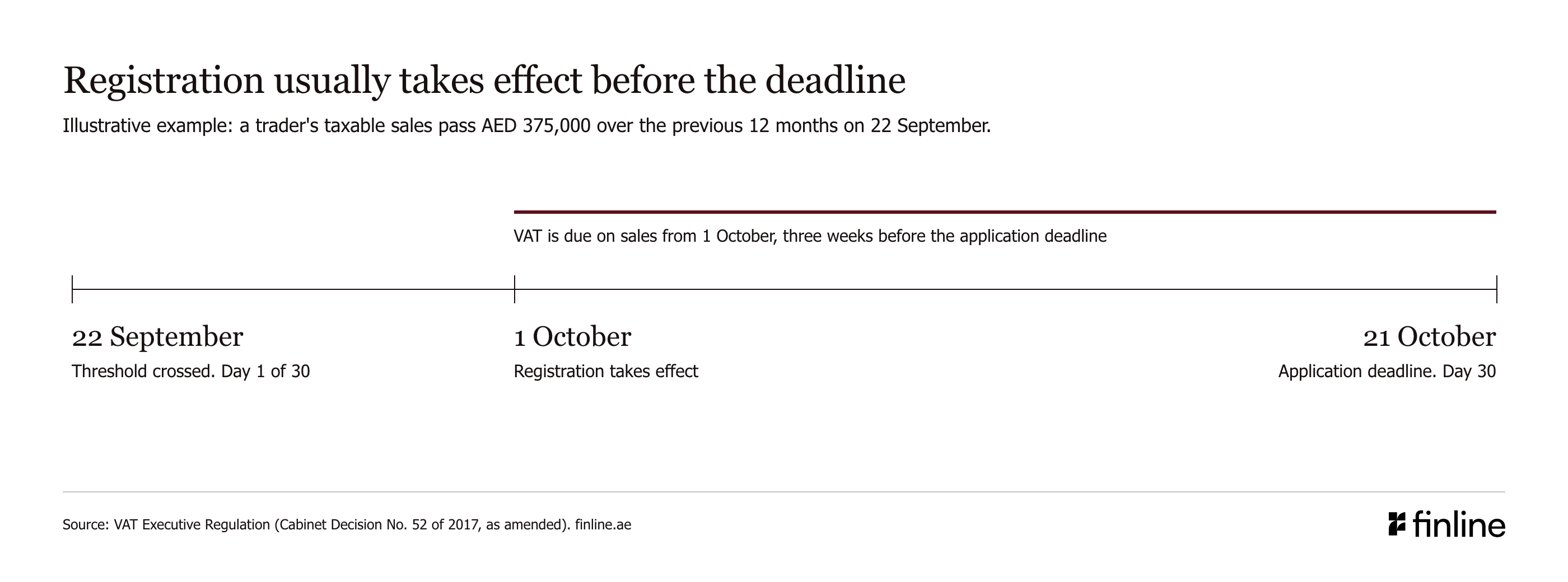
So for most crossing dates, registration takes effect before the deadline runs out, and VAT can be due on sales made before the business has applied or holds a Tax Registration Number (TRN). Only a crossing on the first day or two of a month puts the deadline on or before the effective date.
A tax invoice has to show the supplier's TRN, so none can be issued in that gap. From the effective date the business prices on the basis that VAT is due, records every supply, and issues tax invoices once the TRN arrives [1].
A business that never applies is registered by the FTA anyway, from the date it first became liable [1].
How to register for VAT in the UAE on EmaraTax
Registration is online and free. The business activates an EmaraTax account through UAE Pass, creates a Taxable Person profile, selects Register under Value Added Tax and uploads its licence, owners' Emirates ID and passports, a signed declaration of taxable supplies and monthly sales since establishment, and supporting invoices or contracts. The FTA estimates 20 business days for a complete application (an estimate, not a legal period); the VAT certificate then appears in the e-Services dashboard. The TRN is what customers' finance teams check, as A Valid TRN Used to End the Vendor Check. From 1 October, It Starts It. explains [7].
What late VAT registration costs, in two examples
Missing the deadline carries a single penalty of AED 10,000, an amount the penalty tables in force from 14 April 2026 left unchanged. Pages quoting AED 20,000 use the figure that applied until 28 June 2021 [3][8].
The penalty sits on top of the VAT itself, which is due on every taxable supply and import made from the effective date. Paying the penalty does not settle that tax. If the tax is paid after its due date, a further 14% a year applies, charged monthly. A late return costs AED 1,000, or AED 2,000 for a repeat within 24 months [1][3].
Where a business failed to register, the FTA can assess within 15 years of the date it should have registered. The late-registration penalty waiver the FTA announced on 7 May 2025 applies to Corporate Tax registration, not VAT [9][10].
Illustrative example: the September trader (12-month test). A trader that started on 1 January sold AED 42,000 a month of taxable goods to 31 August (AED 336,000). A stronger September takes cumulative taxable sales to AED 376,500 on 22 September.
- Required to register: 22 September.
- Registration effective: 1 October.
- Application deadline: 21 October [1][4].
Applying on 15 October is on time, and VAT is still due on October sales. Applying on 15 December, about eight weeks late, with October to December sales at AED 42,000 a month, means AED 10,000 plus the VAT on about AED 126,000 of sales, before any late-return or late-payment penalty [1][3].
Illustrative example: one large contract (30-day test). A consultancy has AED 180,000 of taxable fees over the previous 12 months. On 10 March it signs an AED 600,000 engagement, to be delivered and invoiced by 5 April. More than AED 375,000 is now expected in the next 30 days, so it must register [2].
- Registration effective: 10 March, not 1 April.
- Application deadline: 8 April [1][4].
Applying on 20 May means AED 10,000 plus the VAT due on the AED 600,000. Where only part of a contract falls within 30 days under milestone billing, the date-of-supply rules decide which test applies, so the timing is worth checking when the contract is signed [1][3].
Who watches the turnover
A business can know the AED 375,000 figure and still register late. The rolling 12-month total is often nobody's job, so it gets checked at year-end, or when the FTA writes, long after the effective date.
The window moves every month and a single contract can trigger the 30-day test, so the figure needs a monthly check:
- A named owner for the monthly taxable-supplies figure: zero-rated in, exempt and capital asset sales out.
- A check at signing for any contract that could pass AED 375,000 within 30 days.
- On the crossing day, three calendar entries: that day, the effective date and the deadline.
A late VAT registration is rarely a knowledge problem. The rolling 12-month figure has no owner, so nobody looks at it until the FTA does.

The same watch works in reverse. A registered business whose taxable supplies over 12 consecutive months fall below AED 187,500, with no expectation of exceeding that in the next 30 days, must apply to deregister within 20 business days; the FTA's VAT deregistration service page sets out the process [1][2][11].
That figure often sits with one person, the risk covered in Why Compliance Cannot Be Handled by One Person. The same calendar can hold the Corporate Tax dates in UAE Corporate Tax Deadline: Your Filing Date by Financial Year-End (2026). It can also hold the e-invoicing dates under Ministerial Decision 244 of 2025: businesses with revenue below AED 50 million appoint an accredited service provider by 31 March 2027 and go live on 1 July 2027. How to Choose an E-Invoicing ASP covers that choice. Registration and deregistration events sit within Finline's Tax & Compliance work [12].
Sources
1. VAT Executive Regulation (Cabinet Decision No. 52 of 2017), consolidated through Cabinet Decision No. 149 of 2026: Federal Tax Authority (September 2026). https://tax.gov.ae//Datafolder/Files/Legislation/2026/Law-No-8-of-2017-and-its-amendments--09-2026.pdf
2. Federal Decree-Law No. 8 of 2017 on Value Added Tax and its amendments, consolidated through Decree-Law No. 16 of 2024 (the Decree-Law No. 16 of 2025 amendments, in force 1 January 2026, do not change the articles cited): Federal Tax Authority (July 2025). https://tax.gov.ae/Datafolder/Files/Legislation/2025/Federal-Decree-Law-No-8-of-2017-and-amendments.pdf
3. Cabinet Decision No. 40 of 2017 on Administrative Penalties and its amendments, including Cabinet Decision No. 129 of 2025 (in force 14 April 2026): Federal Tax Authority (November 2025). https://tax.gov.ae/Datafolder/Files/Legislation/2025/Cabinet%20Decision%20No.%2040%20of%202017%20and%20its%20amendments%20-%20publishing%2011%202025.pdf
4. Taxable Person Guide for Value Added Tax, VATG001, Issue 2: Federal Tax Authority (June 2018). https://tax.gov.ae/-/media/files/en/pdf/guides/taxable-person-guide-june-2018.pdf
5. Registration for VAT: Federal Tax Authority (updated 6 April 2026). https://tax.gov.ae/en/taxes/Vat/vat.topics/registration.for.vat.aspx
6. Value Added Tax overview: Ministry of Finance (accessed 21 October 2026). https://mof.gov.ae/en/public-finance/tax/vat/
7. VAT Registration service page: Federal Tax Authority (updated 19 August 2026). https://tax.gov.ae/en/services/vat.registration.aspx
8. UAE amends VAT penalty rules: EY Tax News (4 June 2021). https://taxnews.ey.com/news/2021-1124-uae-amends-vat-penalty-rules
9. Federal Decree-Law No. 28 of 2022 on Tax Procedures and its amendments, consolidated through Decree-Law No. 17 of 2025: Federal Tax Authority (December 2025). https://tax.gov.ae/Datafolder/Files/Legislation/2025/Federal%20Decree-Law%20No.%2028%20of%202022%20-%20publishing%2003%2012%202025.pdf
10. Federal Tax Authority to waive penalty for late corporate tax registration: Federal Tax Authority (7 May 2025). https://tax.gov.ae/en/media.centre/news/federal.tax.authority.to.waive.penalty.for.late.corporate.tax.registration.aspx
11. VAT Deregistration service page: Federal Tax Authority (updated 24 September 2026). https://tax.gov.ae/en/services/vat.deregistration.aspx
12. Ministerial Decision No. 244 of 2025 on the Implementation of the Electronic Invoicing System: Ministry of Finance (September 2025). https://mof.gov.ae/wp-content/uploads/2025/09/Ministerial-Decision-No.-244-of-2025-on-the-Implementation-of-the-Electronic-Invoicing-System.pdf
Where does your rolling 12-month figure stand today?
A senior Finline specialist will test your taxable supplies against both thresholds and date your registration obligation. If a date has already passed, they will set out what is owed and how to put it right.
Frequently asked questions
You must register for VAT if your taxable supplies and imports exceeded AED 375,000 in the past 12 months, or if you expect to exceed that amount in the next 30 days. Once you cross the threshold, you have 30 days to submit your registration application through the FTA portal.
If your taxable supplies or expenses exceed AED 187,500 but fall below AED 375,000, you can register voluntarily. This is particularly relevant for startups with significant upfront costs: voluntary registration lets you recover the input VAT on those expenses even before you generate revenue.
Non-resident businesses making taxable supplies in the UAE must register regardless of turnover, unless a UAE-based buyer accounts for the VAT through the reverse charge mechanism.
Neither carries VAT on the sale. The difference is on costs. A zero-rated supply is taxed at 0%, so you recover the input VAT on the costs of making it. An exempt supply carries no VAT and the input VAT on its costs is not recoverable, so that VAT becomes a cost to the business.
A business whose sales are mainly zero-rated, such as exports outside the UAE or international transport, will often be in a refund position. A business with exempt income, such as certain financial services or residential rent, absorbs the VAT on its costs.
The classification also drives the registration test: zero-rated supplies count toward the AED 375,000 threshold and exempt supplies do not.
The current amounts come from Cabinet Decision No. 40 of 2017 as amended by Cabinet Decision No. 129 of 2025, in force since 14 April 2026:
- Late registration: AED 10,000.
- Late return: AED 1,000, or AED 2,000 for a repeat within 24 months.
- Late payment: 14% a year, charged monthly on the unpaid tax.
- Incorrect return: AED 500, unless corrected by the filing deadline or by a voluntary disclosure that does not change the tax due.
- Voluntary disclosure that changes the tax: 1% a month on the difference, with a fixed 15% added if the FTA has already notified an audit.
- Tax invoice or credit note not issued on time: AED 2,500 for each case.
- Records not kept: AED 10,000, or AED 20,000 for a repeat within 24 months. Records not provided in Arabic on request: AED 5,000.
Zero-rated supplies count. Exempt supplies, such as residential rent, and one-off sales of capital assets do not.
30 days. If you crossed the threshold on past sales, registration normally takes effect from the first day of the following month. If you expect to cross it within the next 30 days, it can take effect earlier. VAT is due from the effective date, which can fall before you have applied.
AED 10,000, plus the VAT due on sales since the effective date. Tax paid late carries a further 14% a year, charged monthly.
Yes, unless it asks the FTA for an exception and the FTA grants it. It must tell the FTA within 10 business days if it makes a standard-rated supply.
Once the FTA approves the application on EmaraTax, the certificate is available in the e-Services dashboard. The FTA estimates 20 business days for a complete application.

