Key-Person Risk in UAE SME Compliance: Five Obligations, One Finance Manager, No Backup
UAE SMEs are managing five regulatory obligations at once. The businesses that have assigned all of them to one person are not underprepared. They are structurally exposed.

In short. Key-person risk in UAE compliance is what happens when a filing, a portal login or a review depends on one person, so that person's absence stops it. A UAE SME runs VAT, Corporate Tax, Wage Protection System (WPS) payroll, beneficial-ownership records and e-invoicing readiness in parallel, each with its own deadline and penalty schedule [1][2][3][4][5]. When one finance manager prepares, reviews and submits all of them, a resignation becomes a late return: AED 1,000 for a first late VAT return, plus a monthly penalty at 14% a year on tax left unpaid [6].
- Name an owner and a reviewer for every obligation. One person can own several; nobody reviews their own work.
- Put two people on every system. Link a second user to EmaraTax, name who can take over as Account Admin, and write down how Write Access moves [7]; do the same for the bank, WPS and accounting logins.
- Add an external review layer. A senior reviewer outside the team carries the calendar and the filing history across staff changes.
The Wednesday problem
A finance manager who has handled VAT, WPS and bookkeeping for three years hands in their notice on a Wednesday. The quarterly VAT return is due in 18 days. They are the only user linked to the company's EmaraTax account, and the only one holding Write Access [7]. Two years of supporting documents are in a folder structure only they understand. The Corporate Tax return for the first full financial year is due in four months.
Nothing fraudulent happened and nobody was negligent. The company built its compliance around one person's knowledge and logins. This is key-person risk, also called key man risk.
VAT and Corporate Tax figures should reconcile, and the Federal Tax Authority (FTA) can compare them. A business that misses a filing cycle, or files figures that do not reconcile, gives the FTA a reason to ask for records.
In many UAE SMEs the compliance function is a single point of failure. Fixing it is a question of architecture: who owns, reviews and can access each obligation. Adding headcount does not answer that question.
Five compliance obligations every UAE SME runs in parallel
Each of the five has its own deadlines, portal, document requirements and penalty schedule.
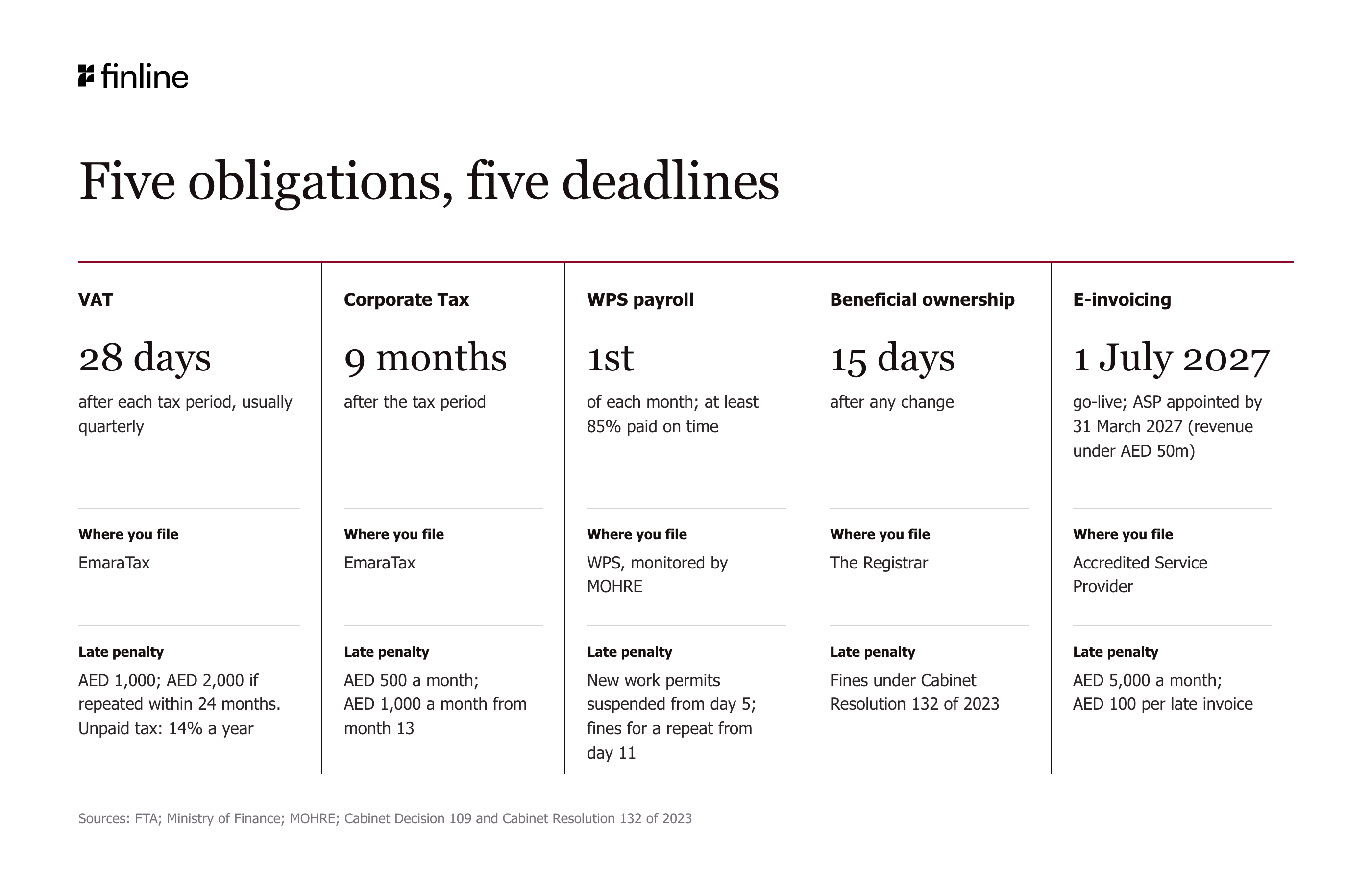
VAT: Return and payment are due within 28 days of the end of each tax period, usually quarterly [1]. Late filing costs AED 1,000, or AED 2,000 if repeated within 24 months. Late payment carries a monthly penalty at 14% a year, for each month or part of a month, from the day after the due date. Both come from Cabinet Decision No. 40 of 2017 as amended by Cabinet Decision No. 129 of 2025, in force since 14 April 2026 [6][8]. Since 1 October 2026, input VAT can be denied where the business knew or should have known a supply was connected to tax evasion; FTA Decision No. 13 of 2026 sets the supplier checks, which adds a vendor-master control to the same person's list [9].
Corporate Tax: The return and payment are due within nine months of the end of the tax period [2]. The Corporate Tax penalty for late filing is AED 500 for each month or part of a month in the first 12 months, and AED 1,000 a month from month 13; the FTA applies the same amounts to late payment [2][10]. The VAT and Corporate Tax returns should reconcile, and the FTA can compare them.
WPS: Under Ministerial Resolution 340 of 2026, establishments registered with the Ministry of Human Resources and Emiratisation (MOHRE) pay the previous month's wages through WPS on the first day of each month; paying at least 85% on time counts as compliant. MOHRE sends alerts from day 2 and suspends new work permits from day 5. From day 11, a repeat within six months brings MOHRE fines and reclassification [3].
Anti-money laundering (AML) and ultimate beneficial owner (UBO) records: Beneficial ownership registers must stay current; changes to beneficial-owner data are filed with the Registrar within 15 days [4]. On 20 May 2025 the Central Bank of the UAE imposed an AED 200 million sanction on an exchange house for significant failures in its anti-money laundering and counter-terrorist financing (AML/CFT) framework, and fined a branch manager AED 500,000 and barred them from holding any position in a UAE licensed financial institution [11]. An exchange house is not an SME, but the case shows the regulator acts on individuals as well as the institution.
E-invoicing: Businesses with revenue below AED 50 million must appoint an Accredited Service Provider (ASP) by 31 March 2027 and go live on 1 July 2027 on Peppol PINT AE, the UAE's national e-invoicing format [5][12]. Ministerial Decision 197 of 2026 left both dates unchanged. Readiness takes three separate workstreams: changes to the ERP or accounting system for structured XML output, master data work (addresses linked to the tax identification number, or TIN, and supplier identifiers), and appointing an ASP from the Ministry of Finance list.
On the audit side, Article 46 of the Tax Procedures Law, as amended by Federal Decree-Law No. 17 of 2025, lets the FTA audit up to five years from the end of a tax period, and 15 years where tax evasion occurred or a business failed to register [13]. For a business where one stretched person missed a registration obligation, the exposure can reach back 15 years rather than five.
In the opening scenario all five sit with one person, and two of them, VAT and Corporate Tax, can carry audit exposure of up to 15 years.
Three ways key-person risk turns into a missed filing
The failures below can happen to a competent finance manager. They come from a system with no redundancy.
The departure problem. This is the opening scenario: a filing is missed because nobody else holds the access or can find the documents. The first missed VAT return costs AED 1,000. If recovery takes two filing cycles, the second late return costs AED 2,000, and the monthly 14%-a-year penalty runs on any unpaid tax from the day after each due date [6]. The penalty is manageable; the larger cost is the attention an irregular filing record draws from the FTA. Under the amended Tax Procedures Law, if the gap amounts to a failure to register, the look-back extends to 15 years instead of the standard five [13].
The cross-reference gap. VAT and Corporate Tax returns should reconcile. When the same person prepares both without a second review, inconsistencies build up from fatigue and a missing check, without any dishonesty. If the FTA asks for records, failing to keep the required records costs AED 10,000, or AED 20,000 for a repeat within 24 months; failing to give the tax auditor the facilitation the law requires costs AED 20,000 [6]. An audit also consumes weeks of management time that most SMEs cannot easily absorb.
The e-invoicing lag. The SME go-live date is 1 July 2027, with the ASP appointment due by 31 March 2027. Those dates look comfortable until implementation is sitting in the to-do column of one finance manager's week. Peppol PINT AE compliance requires sequential work across ERP configuration, master data cleansing and provider onboarding. Each depends on the one before, so if the finance manager running day-to-day compliance also drives the project, something is likely to slip. The fines are AED 5,000 a month for failing to implement e-invoicing or to appoint an Accredited Service Provider on time, plus AED 100 for each invoice not issued or sent on time, capped at AED 5,000 a month [14].
Segregation of duties without a compliance team: three layers
None of the three layers below requires a new hire.
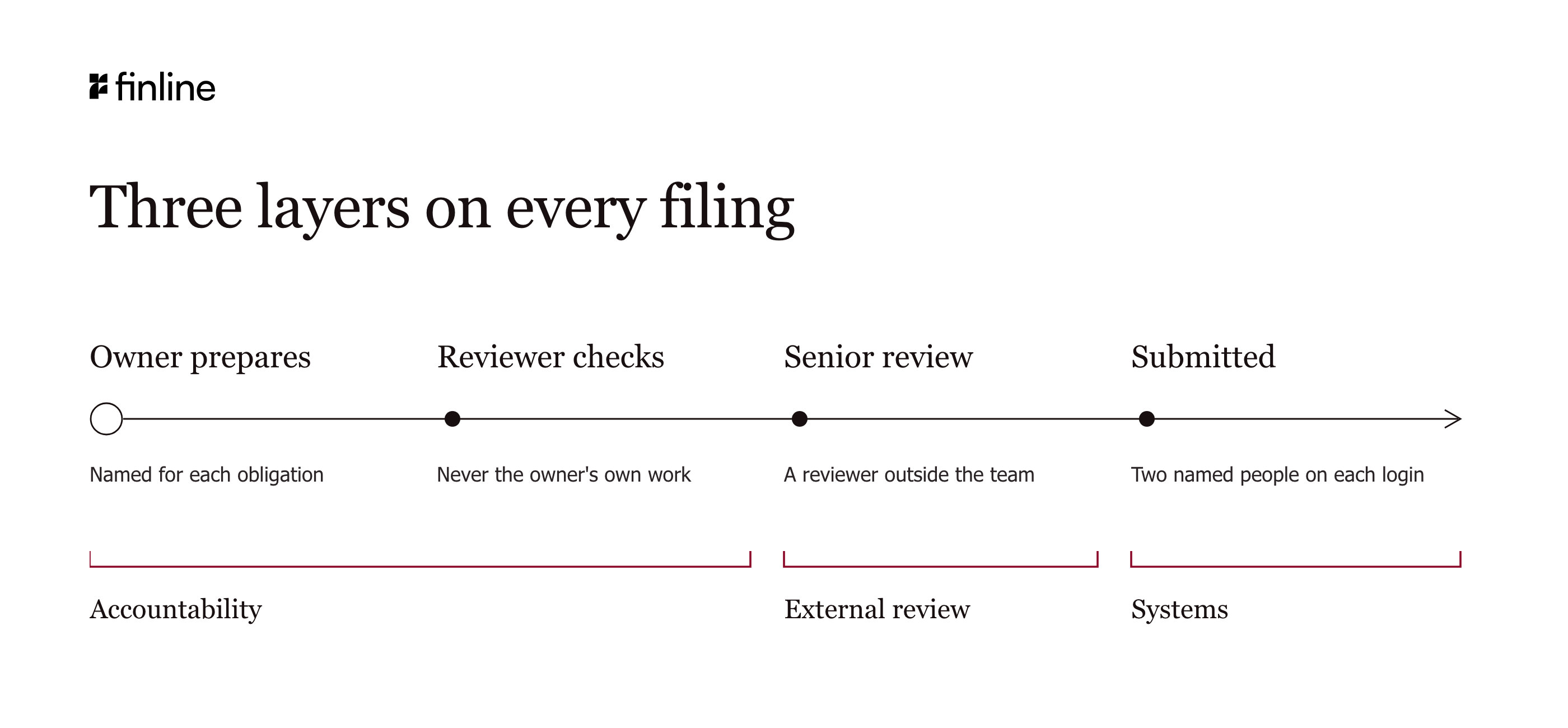
Layer 1: Make accountability explicit.
Every compliance obligation needs a named owner and a named reviewer. One person can own several obligations, but the owner is never the only reviewer of their own work.
The finance manager owns VAT preparation and Corporate Tax preparation. The founder or a senior operations lead reviews both before submission. AML/UBO ownership sits with whoever manages the company register, with a calendar reminder for the 15-day reporting obligation when anything changes. E-invoicing readiness has a named project lead with a timeline, separate from the person handling quarterly filings.
In a three-person finance team, the split Atul Bhargava recommends is: one person prepares, a second approves and submits, and the founder or an external reviewer holds bank and WPS release. FTA Decision 13 already expects this shape for supplier checks: a written policy that names who implements and who reviews [9].
None of this needs restructuring: it takes one conversation and a written record of who owns what.
Layer 2: Use technology as compliance infrastructure.
Many UAE SMEs use their accounting software for bookkeeping and not as a governance tool.
Cloud accounting systems (Zoho Books, Xero, QuickBooks) support multi-user access with role-based permissions. That means the ledger and the document repository are not locked to one person's device or login. They also automate VAT calculations and generate FTA-compatible reports, which cuts the margin for manual error on the most frequent compliance task the business faces.
Set deadline alerts to notify two people, so a missed notification to one person does not mean a missed filing.
EmaraTax needs more care. The Account Admin can link several FTA-registered users with Display or Write Access, but only one user holds Write Access at a time, and only the Account Admin grants it [7]. So link a second person, name who can be made Account Admin through the portal's "Make Admin" option, and write down the step for moving Write Access. Apply the same two-person setup to the bank portal, the WPS submission login and the accounting system's admin role. The list of systems with two named users each is the first page of the compliance file.
For e-invoicing, the requirement sits in the system itself. By 1 July 2027 the accounting or ERP system must generate structured XML invoices in Peppol PINT AE format and send them through an ASP. Run it as a technology project with a named owner, a readiness assessment and a timeline, kept separate from whoever handles quarterly VAT.
Layer 3: Add an external review layer.
Guildhall's Dubai Salary Guide 2026 puts an SME CFO at AED 59,000 to 89,000 a month in fixed pay (basic plus allowances, before bonus), roughly AED 0.7 to 1.1 million a year [15]. Visa, medical insurance and end-of-service gratuity come on top. For many SMEs a full-time hire at that level is hard to justify, and the governance work a CFO does (reviewing returns before submission, flagging regulatory changes, keeping institutional knowledge when staff turn over) does not need one.
Many UAE businesses use a fractional or outsourced finance model for this reason. A senior finance professional on retainer reviews compliance outputs, maintains the calendar and provides continuity when internal staff change. When the finance manager from the opening scenario hands in their notice, the external advisor knows the filing schedule, is linked to EmaraTax and holds the document history, so the handover does not interrupt a filing.
Compliance stays with the internal team; the external layer keeps that team working through staff changes. Finline's Tax & Compliance work provides that review layer alongside the client's own finance team.
Five questions to test your compliance structure
These are quick.
- If your finance manager resigned today, who else is linked to EmaraTax, who can take Write Access, and who knows when the next VAT return is due?
- Does anyone review your VAT return before submission, or does the same person who prepares it also submit it?
- Is your compliance calendar written down and visible to at least two people, or does it exist only in someone's head?
- Who owns e-invoicing readiness ahead of the 31 March 2027 ASP appointment and the 1 July 2027 go-live, and have they mapped the ERP and master data work?
- In the last 12 months, has any compliance deadline been missed or nearly missed? If yes, was the root cause a system failure or a person-dependency?
If most honest answers are "not sure" or "just one person", the three layers above are where to start.
Compliance doesn't break because someone made a mistake. It breaks because the setup assumed one person would always be available, always current, and always right.

Sources
1. Filing VAT returns and making payments: Federal Tax Authority (accessed 21 October 2026). https://tax.gov.ae/en/taxes/Vat/vat.topics/filing.vat.returns.and.making.payments.aspx
2. FTA emphasises submitting Corporate Tax returns and settling payable tax within deadlines: Federal Tax Authority (14 September 2025). https://tax.gov.ae/en/media.centre/news/federal.tax.authority.emphasises.the.need.to.submit.tax.returns.and.settle.corporate.tax.payable.within.specified.deadlines.to.avoid.late.payment.penalties.aspx
3. Payment of salaries/wages (Ministerial Resolution No. 340 of 2026): UAE Government portal u.ae (updated 14 October 2026). https://u.ae/en/information-and-services/jobs/Sector-of-employment/employment-in-the-private-sector/payment-of-wages
4. Cabinet Decision No. 109 of 2023 Regulating Beneficial Owner Procedures: CBUAE Rulebook (2023). https://rulebook.centralbank.ae/en/rulebook/cabinet-decision-no-109-2023-regulating-beneficial-owner-procedures
5. Ministry of Finance announces two Ministerial Decisions on the scope and timelines of the e-invoicing system: UAE Ministry of Finance (29 September 2025). https://mof.gov.ae/en/news/ministry-of-finance-announces-the-issuance-of-two-ministerial-decisions-on-the-scope-of-obligations-and-the-timelines-for-implementing-the-electronic-invoicing-system-2/
6. Cabinet Decision No. 40 of 2017 on Administrative Penalties for Violations of Tax Laws, and its amendments (incl. Cabinet Decision No. 129 of 2025): UAE Ministry of Finance (November 2025). https://mof.gov.ae/wp-content/uploads/2025/11/Cabinet-Decision-No.-40-of-2017-and-its-amendments-v14.11.25.pdf
7. User Authorization user manual, v1.0.0.0: Federal Tax Authority (October 2022). https://tax.gov.ae/DownloadOpenTextFile?fileUrl=en%2FVAT_General_Procedures%2FManage_Online_User%2FLink_multiple_User_EN.pdf
8. FTA announces entry into force of the decision amending administrative penalties: Federal Tax Authority (15 April 2026). https://tax.gov.ae/en/media.centre/news/federal.tax.authority.announces.entry.into.force.of.the.decision.amending.administrative.penalties.imposed.for.violations.of.tax.legislation.and.calls.on.registrants.to.benefit.from.the.advantages.of.the.new.decision.aspx
9. FTA Decision No. 13 of 2026 on measures for verifying suppliers and supplies: Federal Tax Authority (published 20 August 2026, effective 1 October 2026). https://tax.gov.ae/Datafolder/Files/Legislation/2026/FTA%20Decision%20No.%2013%20of%202026%20on%20Measures%2018%2008%202026.pdf
10. Cabinet Decision No. 75 of 2023 on Administrative Penalties for Corporate Tax, and its amendments: UAE Ministry of Finance (March 2024). https://mof.gov.ae/wp-content/uploads/2024/03/Cabinet-Decision-No.-75-of-2023-and-its-amendments-on-the-Administrative-Penalties-for-Violations-Related-to-the-Application-of-Federal-Decree-Law-No.-47-of-2022.pdf
11. CBUAE imposes a financial sanction of AED 200 million on an exchange house: Central Bank of the UAE (20 May 2025). https://centralbank.ae/media/u1yfjiyi/cbuae-imposes-a-financial-sanction-of-aed-200-million-on-an-exchange-house-en.pdf
12. Ministry of Finance announces targeted amendments to e-invoicing system decisions: UAE Ministry of Finance (10 May 2026). https://mof.gov.ae/en/news/ministry-of-finance-announces-targeted-amendments-to-einvoicing-system-decisions/
13. Federal Decree-Law No. 28 of 2022 on Tax Procedures and its amendments (consolidated): Federal Tax Authority (3 December 2025). https://tax.gov.ae/Datafolder/Files/Legislation/2025/Federal%20Decree-Law%20No.%2028%20of%202022%20-%20publishing%2003%2012%202025.pdf
14. Ministry of Finance announces Cabinet Resolution on administrative fines related to the e-invoicing system (Cabinet Resolution No. 106 of 2025): UAE Ministry of Finance (8 December 2025). https://mof.gov.ae/en/news/ministry-of-finance-announces-the-issuance-of-cabinet-resolution-on-administrative-fines-related-to-electronic-invoicing-system/
15. Dubai Salary Guide 2026: Guildhall (30 August 2026). https://guildhall.agency/dubai-salary-guide-2026/
Is your compliance setup built around a person or a system?
A senior finance specialist will map who owns, reviews and can access each of your five obligations, and show you where one absence would stop a filing.
Frequently asked questions
Every company licensed on the mainland or in a commercial free zone keeps a register of its beneficial owners and a register of partners or shareholders. Under Cabinet Decision 109 of 2023 it files both with its Registrar, the licensing authority, within 60 days of licensing. A beneficial owner is a natural person who owns or controls 25% or more of the capital or voting rights, directly or through a chain of ownership, or who controls the company by other means.
Any change goes to the Registrar within 15 days. ADGM and DIFC run their own regimes, and companies wholly owned by federal or local government are exempt. Under Cabinet Decision 132 of 2023, a first breach usually brings a written warning with time to correct it. Repeat breaches bring fines from AED 5,000 to AED 100,000, and a third can lead to licence suspension.
It depends on your sector and where you are licensed. The Ministry of Economy and Tourism supervises real estate brokers and agents, dealers in precious metals and stones, auditors and accountants, and corporate service providers on the mainland and in commercial free zones, and inspects them for AML compliance. Lawyers, notaries and legal consultants are supervised by the Ministry of Justice. Entities in ADGM and DIFC answer to their zone's regulator: the FSRA in ADGM and the DFSA in DIFC. Your supervisor sets the inspections, the guidance and the penalties, so confirm which one applies before you write your AML policies.
AED 500 for each month or part of a month the return is late, for the first 12 months, and AED 1,000 a month from month 13. The return and payment are both due nine months after the end of the tax period.
Paying late is a separate penalty: 14% a year on the unpaid tax, charged monthly from the day after the due date.
Source: Cabinet Decision No. 75 of 2023, as amended.
Key-person risk is the risk that a filing, a portal login or an approval depends on one person, so their absence stops it. In a UAE business it shows up as a late VAT or Corporate Tax return, a missed WPS payroll cycle or a beneficial-owner change nobody filed.
Each has a set consequence: AED 1,000 for a first late VAT return; AED 500 for each of the first 12 months a Corporate Tax return is late; MOHRE alerts from day 2 of late wages and a block on new work permits from day 5; and 15 days to file a beneficial-owner change with the Registrar.
The fix has three parts: a named owner and reviewer for every obligation, at least two people on every system, and an external review.
Sources: Cabinet Decision No. 40 of 2017 on administrative penalties for violations of tax laws, as amended by Cabinet Decision No. 129 of 2025; Cabinet Decision No. 75 of 2023 on administrative penalties for Corporate Tax; Ministerial Resolution No. 340 of 2026 on the payment of wages; Cabinet Decision No. 109 of 2023 regulating beneficial owner procedures.
The VAT return and payment are due within 28 days of the end of the tax period. The VAT penalty for late filing is AED 1,000 for the first late return and AED 2,000 if it is repeated within 24 months. Late payment carries a monthly penalty at 14% a year, for each month or part of a month, from the day after the due date. These amounts come from Cabinet Decision No. 40 of 2017 as amended by Cabinet Decision No. 129 of 2025, in force since 14 April 2026.
Sources: Filing VAT returns and making payments. Cabinet Decision No. 40 of 2017 on Administrative Penalties for Violations of Tax Laws, and its amendments (incl. Cabinet Decision No. 129 of 2025). FTA announces entry into force of the decision amending administrative penalties.
One person prepares returns and reconciliations, and a second approves and submits them. The founder or an external reviewer releases bank and WPS payments and reviews the reconciliations, so nobody approves their own work.
UAE tax law does not prescribe a team structure. FTA Decision No. 13 of 2026 expects the same shape for supplier checks: a written policy that names who carries out the checks and who reviews them.
Sources: FTA Decision No. 13 of 2026 on measures for verifying suppliers and supplies.


