Fractional, Outsourced or In-House CFO: Which Does Your UAE Business Need?
Most UAE businesses ask which CFO model to use before deciding whether they need CFO-level oversight at all. Here is how to answer both questions, with the FTA relationship as the deciding factor.
In short. A bookkeeper records transactions and an accountant checks them; a CFO makes the decisions that sit above them. Most UAE businesses need those decisions made before they can justify a full-time hire, and a fractional CFO is usually the first answer. The FTA relationship usually forces the question: corporate tax positions need an owner, and e-invoicing must be live by 1 July 2027 for businesses in scope with revenue under AED 50 million [1].
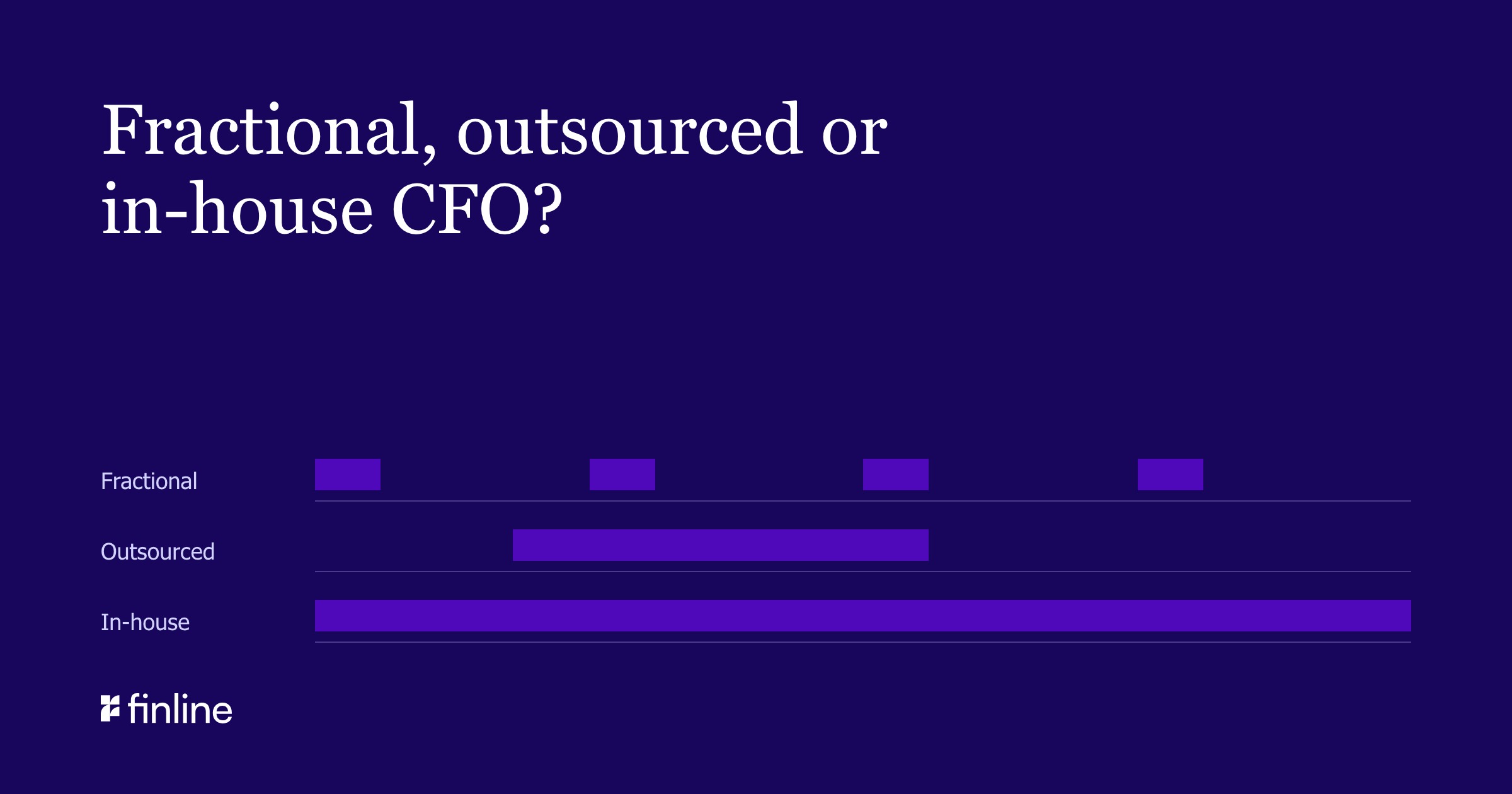
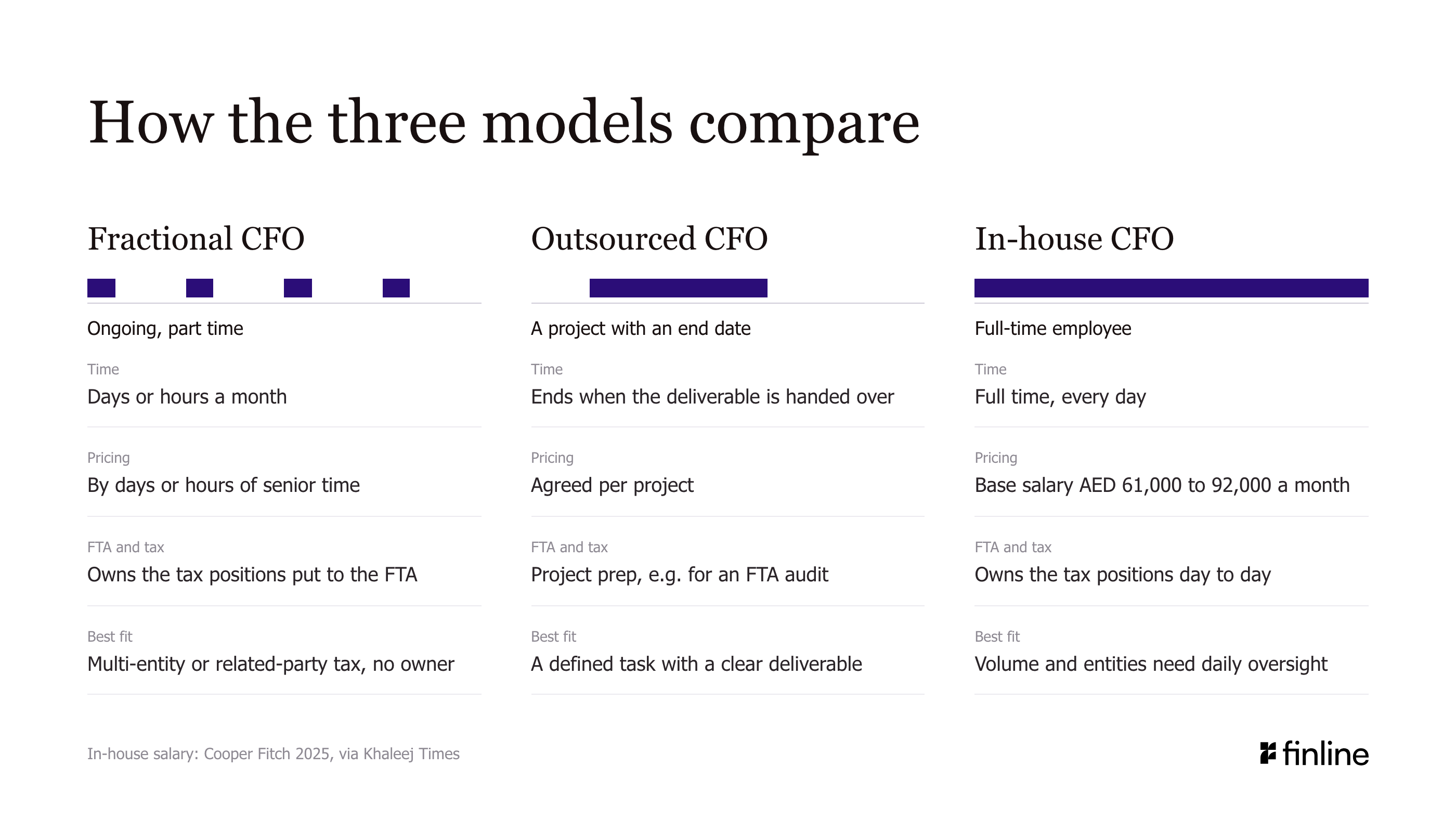
- Fractional CFO: a standing part-time commitment, priced by days or hours of senior time a month. It is the closest thing to an in-house CFO without the employment cost.
- Outsourced CFO: either the same as fractional, or a project with a scope and an end date. Ask which one you are buying. A virtual CFO is usually one of these, delivered remotely.
- In-house CFO: a full-time hire, justified when entity count, transaction volume or capital activity needs daily oversight.
Many businesses take the CFO question in the wrong order. They ask which model to use before they have decided whether they need CFO-level financial oversight at all. Getting the structure wrong costs more now that corporate tax is in force and e-invoicing runs to fixed dates.
A CFO, or someone working at that level, looks forward: at financial structure, regulatory positions, and what banks and investors will ask next.
Six signs a UAE business has outgrown its finance function
The gap between keeping accurate books and making decisions with them usually goes unnoticed until one of these situations comes up:
- Corporate tax is no longer straightforward. You have more than one entity, intercompany transactions, or free zone and mainland operations running in parallel. Filing now takes judgment on positions, documentation and the timing of elections. Under the Corporate Tax Law (Federal Decree-Law No. 47 of 2022), related-party transactions must be priced at arm's length, and the business has to be able to show that they are.
- The FTA has been in contact, or is likely to be. An inspection visit, a request for records, a VAT audit or an earlier return to correct each needs a person who knows the rules and how your numbers were built, and who can stand behind what the business tells the FTA.
- A bank, investor or counterparty is asking financial questions. Covenant reporting, due diligence and board-level projections need a finance function that can produce reliable figures when asked, without rebuilding the reports each time.
- The business is growing faster than the finance function can track. Cash flow surprises you and margins are less clear than they should be. Decisions rest on the bank balance rather than on management accounts.
- You are appointing an e-invoicing ASP and nobody owns the ERP side. If revenue is under AED 50 million and you are in scope, the Accredited Service Provider must be appointed by 31 March 2027 [1]. Choosing an ASP is a systems and data decision as much as a tax one.
- Revenue is nearing AED 3 million. Small Business Relief is available for tax periods ending on or before 31 December 2029, but only while revenue stays at or below AED 3 million [2]. Above that line the election is no longer available, and the business prepares a full corporate tax computation.
None of these situations calls for a full-time CFO as the first response. Each calls for CFO-level judgment, which is what fractional CFO services are set up to provide.
Fractional, outsourced, virtual and in-house CFO: what each model means
The UAE market uses several terms for the engagement, often interchangeably.
Fractional CFO. An ongoing, embedded role. The CFO works part time in your business on a fixed cadence and is priced by days or hours of senior time a month. They attend leadership meetings, own the planning and forecasting cycle, and keep continuity between sessions. The function is the same as a full-time internal CFO's; the employment structure is different.
Virtual CFO. In the UAE market this usually means a fractional or outsourced CFO working remotely, often packaged with bookkeeping. The label describes how the work is delivered and says nothing about scope, so ask the same questions you would ask of a fractional engagement.
Outsourced CFO. The term can describe the same thing as fractional: an ongoing retained engagement with a regular cadence and ownership of the financial plan. It can also mean a project with a defined mandate, a scope and a close date, such as fundraising preparation, preparing for an FTA audit, a systems implementation or due diligence support. That work ends when the deliverable is handed over. Cost and depth of involvement differ between the two.
In-house CFO. A full-time employee, present every day, with full employment costs: base salary, housing allowance, visa, medical insurance, gratuity and performance bonus. One person also holds most of the knowledge of how the numbers were built, which is a key-person risk. This model is right when transaction complexity, entity count or capital activity requires someone available every day.
No model is better in every case. The choice depends on what the business needs its finance function to do.
The FTA and MoF relationship is the deciding factor
The Federal Tax Authority administers corporate tax, VAT and excise tax. The Ministry of Finance sets tax policy and issues ministerial decisions, and cabinet decisions add rules such as penalties. Businesses are expected to apply each one correctly from its effective date.
The FTA carried out about 176,000 field inspection visits in 2025, up about 89% on 2024, and identified more than AED 608 million in tax dues and penalties [3]. Most visits check tax invoices, excise goods and tax stamps rather than corporate tax files. They still show an authority that is present in the market and acts on what it finds.
In an inspection or audit, the business must produce records, reconcile positions and answer queries within set timeframes. Under the Tax Procedures Law (Federal Decree-Law No. 28 of 2022), the FTA has broad powers to request information and documentation. Explaining the filing positions behind those records is work above transaction-level accounting. The business stays responsible for its tax affairs. It can appoint an FTA-registered tax agent to represent it [4]; a CFO's job is to own the positions that agent, or the business's own signatories, put to the FTA.
Since 1 January 2026, an amended Tax Procedures Law lets many errors be corrected in the next return; a voluntary disclosure is required in the cases the FTA specifies [5]. Which route applies, and when it is used, affects the outcome. With CFO-level review, the business finds its own errors before the FTA does.
New FTA rules also reach the finance leader directly. From 1 October 2026, FTA Decision 13 sets the checks a business must run on its suppliers before it deducts input VAT [6].
E-invoicing is the most immediate MoF example. A business in scope with revenue below AED 50 million must appoint an Accredited Service Provider by 31 March 2027 and implement the system by 1 July 2027 (Ministerial Decision 244 of 2025, Article 5(1)(b)) [1]. Business-to-consumer transactions are outside the system for now [1]. PDF, Word, scanned copies and emails are not e-invoices [7]. Failing to implement the system, including failing to appoint an ASP in time, costs AED 5,000 for each month or part of a month [8]. Working out what the system requires, updating the ERP and appointing the provider is work for finance leadership, beyond the scope of the accounts team.
Managing the FTA and MoF relationship is a financial leadership task, and it belongs with someone who can explain how the numbers were built.

Which CFO model fits which business
Revenue is a starting point, but it does not settle the question. Two businesses at the same revenue can need very different CFO support: one with a single entity and no related-party transactions, the other with a free zone holding company, a mainland operating entity and intercompany service agreements. The complexity of the compliance picture decides it.
An ongoing fractional or retained outsourced model is usually right when corporate tax is a live obligation with more than one entity or meaningful related-party activity, and the person running your finance function does not have the time or remit to own FTA correspondence, evidence arm's length pricing on related-party transactions, or model your tax position for the year ahead. Many growing UAE businesses are in this position: their compliance load has outgrown a finance function built for bookkeeping.
Small businesses have a relief to factor in. Small Business Relief (Article 21 of the Corporate Tax Law, Ministerial Decision 73 of 2023 as amended by Ministerial Decision 131 of 2026) is available for tax periods ending on or before 31 December 2029 while revenue stays at or below AED 3 million [2]. A business that elects it is exempt from Transfer Pricing documentation for that period, but the arm's length principle still applies [9]. Master and local files are required only at AED 200 million revenue or inside an MNE group with AED 3.15 billion consolidated revenue [10].
A project-based outsourced engagement fits a defined task with a clear deliverable: preparing for an FTA inspection, building investor-ready financial models, implementing a new finance system, or responding to a specific regulatory query. The engagement has a scope and closes on completion.
An in-house CFO becomes the right answer when the business consistently generates the transaction volume and entity complexity that need daily financial oversight. When multi-entity reporting, bank relationships and board-level financial communication all run continuously, a full-time seat is justified. Reaching the Transfer Pricing file thresholds above is one clear marker.
What a fractional CFO costs against a full-time hire
The usual benchmark is a full-time CFO. Cooper Fitch 2025 data, as reported by Khaleej Times, puts the base salary of a full-time CFO at a UAE SME at AED 61,000 to 92,000 a month [11], or roughly AED 732,000 to 1.1 million a year before housing, benefits, visa and gratuity. For many growing businesses, that cost is out of proportion to what the role would deliver day to day.
Fractional engagements are priced by days or hours of senior time a month. The useful comparison is between the days of senior time the business needs and the cost of a full-time seat: a few days around the close and the board pack is a different engagement from two days a week through a refinancing.
The absence of financial leadership has a cost too. An incorrectly filed corporate tax return, an undocumented related-party transaction or a VAT position that needs correcting later usually surfaces as penalties and rework. Late corporate tax registration carries an AED 10,000 penalty, waived if the first return is filed within seven months of the end of the first tax period [12]. Missing the e-invoicing deadlines adds AED 5,000 for each month or part of a month [8].
A hire can also be too senior. A CFO profile built for a much larger business costs more than the current stage needs. The structure should match what the business needs now and change as its regulatory and operational picture develops.
Sources
1. Ministerial Decision No. 244 of 2025 on the Implementation of the Electronic Invoicing System: UAE Ministry of Finance (2025). https://mof.gov.ae/wp-content/uploads/2025/09/Ministerial-Decision-No.-244-of-2025-on-the-Implementation-of-the-Electronic-Invoicing-System.pdf
2. Ministerial Decision No. 131 of 2026 amending Ministerial Decision No. 73 of 2023 on Small Business Relief: UAE Ministry of Finance (2026). https://mof.gov.ae/wp-content/uploads/2026/08/Ministerial-Decision-No.-131-of-2026-Amending-Certain-Provisions-of-Ministerial-Decision-No.-73-of-2023-on-Small-Business-Relief-for-the-Purposes-of-Federal-Decree-Law-No.-47-of-2022-EN.pdf ; announcement: Ministry of Finance announces extension of Small Business Relief until 31 December 2029: UAE Ministry of Finance (7 August 2026). https://mof.gov.ae/en/news/ministry-of-finance-announces-extension-of-small-business-relief-for-corporate-tax-purposes-until-31-december-2029/
3. Federal Tax Authority conducted 176,000 market inspection visits in 2025, up 89% year-on-year: Federal Tax Authority (7 April 2026). https://tax.gov.ae/en/media.centre/News/federal.tax.authority.conducted.176000.market.inspection.visits.in.2025.up.89.yearonyear.aspx
4. Registration of Tax Agents: Federal Tax Authority (accessed 21 October 2026). https://tax.gov.ae/en/services/registration.of.tax.agents.aspx
5. Federal Decree-Laws No. 16 and 17 of 2025: KPMG Lower Gulf (2025). https://kpmg.com/ae/en/insights/tax-insights/federal-decree-law-no-16-and-17-of-2025.html
6. Federal Tax Authority Decision No. 13 of 2026 on the Measures, Procedures and Conditions required by Taxable Persons for the Verification of the Validity and Integrity of the Supplies before Deduction of Input Tax (unofficial English translation; effective 1 October 2026): Federal Tax Authority (22 July 2026). https://tax.gov.ae/Datafolder/Files/Legislation/2026/FTA%20Decision%20No.%2013%20of%202026%20on%20Measures%2018%2008%202026.pdf
7. eInvoicing: UAE Ministry of Finance (accessed 21 October 2026). https://mof.gov.ae/en/about-us/initiatives/einvoicing/
8. Cabinet Decision No. 106 of 2025 on Violations and Administrative Penalties for the Electronic Invoicing System: UAE Ministry of Finance (8 December 2025). https://mof.gov.ae/wp-content/uploads/2025/12/Cabinet-Decision-Violations-and-Penalties-eInvoicing-final-version-en-8.12.25.pdf
9. Small Business Relief Guide (CTGSBR1), section 5.6.1: Federal Tax Authority (August 2023). https://tax.gov.ae/Datafolder/Files/Guides/CT/Small%20Business%20Relief%20Guide%20-%20EN%20-%2029%2008%202023.pdf
10. Requirements for maintaining Transfer Pricing documentation (Ministerial Decision No. 97 of 2023): Deloitte Middle East (2023). https://www.deloitte.com/middle-east/en/services/tax/research/requirements-maintaining-transfer-pricing-documentation.html
11. Why more UAE businesses are renting their C-suite executives instead of hiring them (citing Cooper Fitch 2025 data): Khaleej Times (10 August 2026). https://www.khaleejtimes.com/business/why-more-uae-businesses-are-renting-their-c-suite-executives-instead-of-hiring-them
12. Cabinet Decision No. 75 of 2023 and its amendments on administrative penalties for Corporate Tax: UAE Ministry of Finance (2024). https://mof.gov.ae/wp-content/uploads/2024/03/Cabinet-Decision-No.-75-of-2023-and-its-amendments-on-the-Administrative-Penalties-for-Violations-Related-to-the-Application-of-Federal-Decree-Law-No.-47-of-2022.pdf ; waiver: Corporate Tax Registration: Federal Tax Authority (accessed 21 October 2026). https://tax.gov.ae/en/services/corporate.tax.registration.aspx
Not sure which CFO model fits your stage?
Atul Bhargava, a Chartered Accountant with 30 years running finance functions, will tell you whether you need CFO-level oversight yet, and in what form.
Frequently asked questions
A fractional CFO is a senior finance leader on a standing part-time commitment: a fixed cadence of days or hours a month. Between sessions they own the business's financial planning, forecasting and reporting cycle. The function is the same as an in-house CFO's; the employment structure is different. UAE regulation does not define the role, so the scope sits in the engagement letter.
In UAE usage, the difference is mostly delivery. A virtual CFO is usually a fractional or outsourced CFO working remotely, often packaged with bookkeeping. The label does not tell you the scope, so ask the same questions of both: how often the CFO works on the business, who owns which deliverables, and who signs off the positions taken with the FTA, the bank and the board.
Cooper Fitch 2025 data, as reported by Khaleej Times, puts the base salary of a full-time CFO at a UAE SME at AED 61,000 to 92,000 a month, before housing, benefits, visa and gratuity. A fractional CFO is priced by days or hours of senior time a month. The useful comparison is the number of senior days the business needs against the cost of a full-time seat.
Source: Khaleej Times (10 August 2026), citing Cooper Fitch 2025 data
When entity count, transaction volume, capital activity, or board and lender reporting need attention every day rather than on a monthly cadence. One clear marker is the Transfer Pricing file threshold: master and local files are required at AED 200 million revenue in a tax period, or for a member of an MNE group with AED 3.15 billion consolidated revenue. Below that, the test is whether the business needs a senior finance decision-maker every day or a few days a month.
Source: Ministerial Decision No. 97 of 2023 on transfer pricing documentation, UAE Ministry of Finance
The business stays responsible for its tax affairs. Representation before the FTA runs through an FTA-registered tax agent the business appoints, or through the business's own authorised signatories on EmaraTax. An outsourced CFO prepares and owns the positions behind each filing and response, and works with whoever represents the business.
Not entirely. Small Business Relief is available for tax periods ending on or before 31 December 2029 while revenue stays at or below AED 3 million. A business that elects it still registers for corporate tax, files a return to make the election, and prices related-party dealings at arm's length, though Transfer Pricing documentation does not apply for that period. The need for oversight returns as revenue approaches the threshold.
Sources: Ministerial Decision No. 131 of 2026, UAE Ministry of Finance; Small Business Relief Guide (CTGSBR1), Federal Tax Authority
Yes. We can run the finance function end to end, or take specific pieces alongside your team, your ERP and your auditor: the close review, the tax positions or the CFO reporting. When volume spikes or a system migration lands, we add people to your existing process under the same reviewer rather than changing it, so your team keeps the process.

