FTA Tax Audit UAE: Reconciling VAT Supplies to Corporate Tax Revenue
The FTA holds both returns and can ask why VAT supplies and Corporate Tax revenue differ. Most of the gap is legitimate. What matters is a bridge written down before the question arrives.
In short. Ahead of any Federal Tax Authority (FTA) tax audit, UAE businesses should be able to explain why the supplies in their VAT returns differ from the revenue in their Corporate Tax return. The FTA holds both returns and can inspect the accounting system behind them. Most of the gap is legitimate, so the exposure is a gap nobody has documented. [1][2][3]
- Bridge the two totals every year. Reconcile Boxes 1, 4 and 5 of the VAT returns to Corporate Tax revenue, item by item, with a reason for each. [2][3]
- Sign it and keep it for seven years. Seven years matches the Corporate Tax record-keeping period and runs past the five-year VAT base. [4][1]
- Fix the tags at source. E-invoicing requires each invoiced supply's tax category to be reported to the FTA, so the ledger must carry it correctly from go-live. [5][6]
Why the FTA can ask you to explain the gap
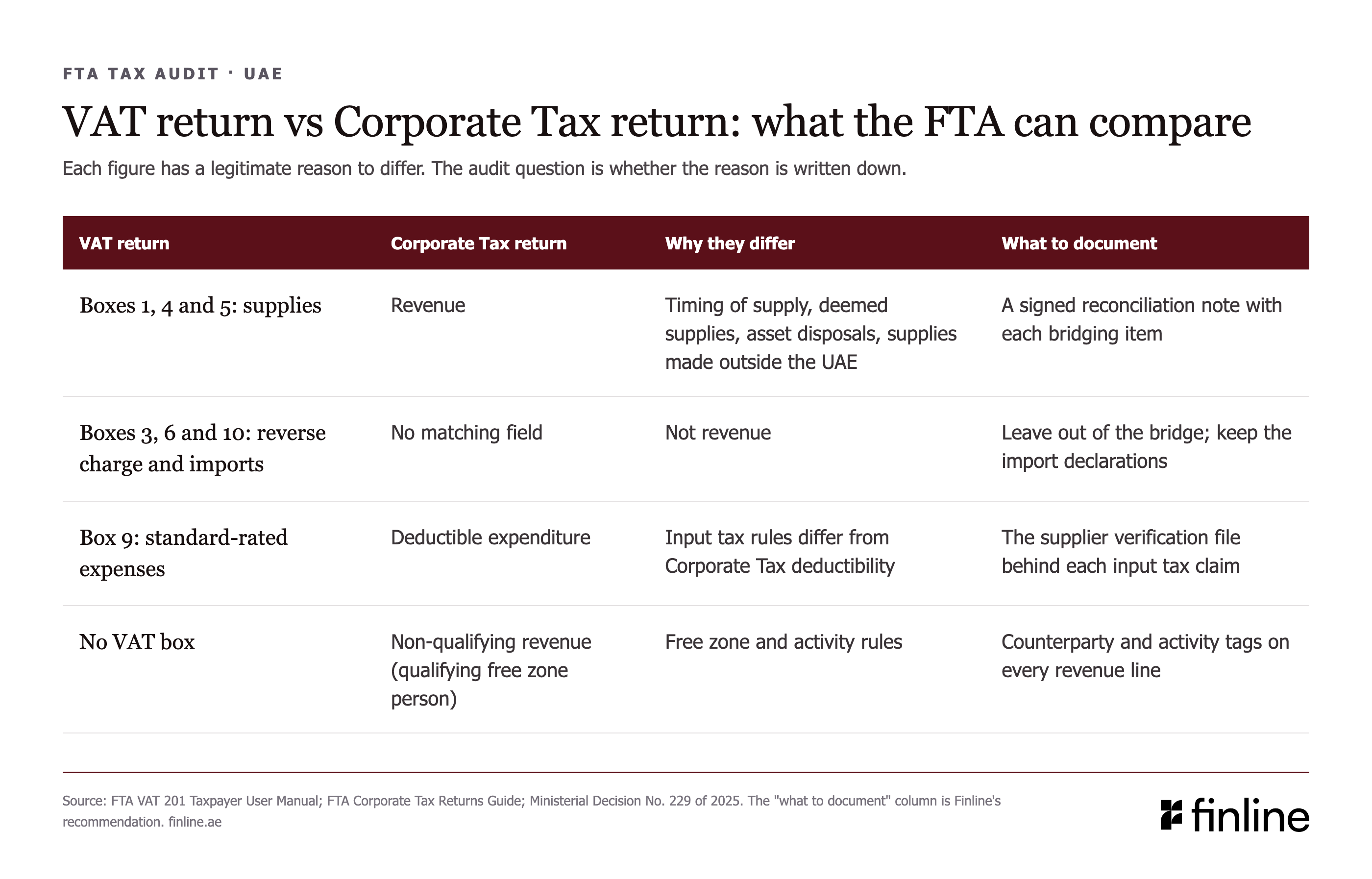
Both returns carry a turnover figure. The Corporate Tax return asks for revenue, which the FTA's return guide defines as gross income from all sources before any expenses or reliefs. The VAT return reports supplies in Box 1 (standard rated, by emirate), Box 4 (zero rated) and Box 5 (exempt). [3][2]
The FTA can inspect electronic records and the accounting systems a business uses, and require documents in the form and period it sets. It already pre-populates Box 6 from customs data, and the Ministry of Finance says e-invoicing will facilitate pre-populating certain VAT return fields. [1][2][6]
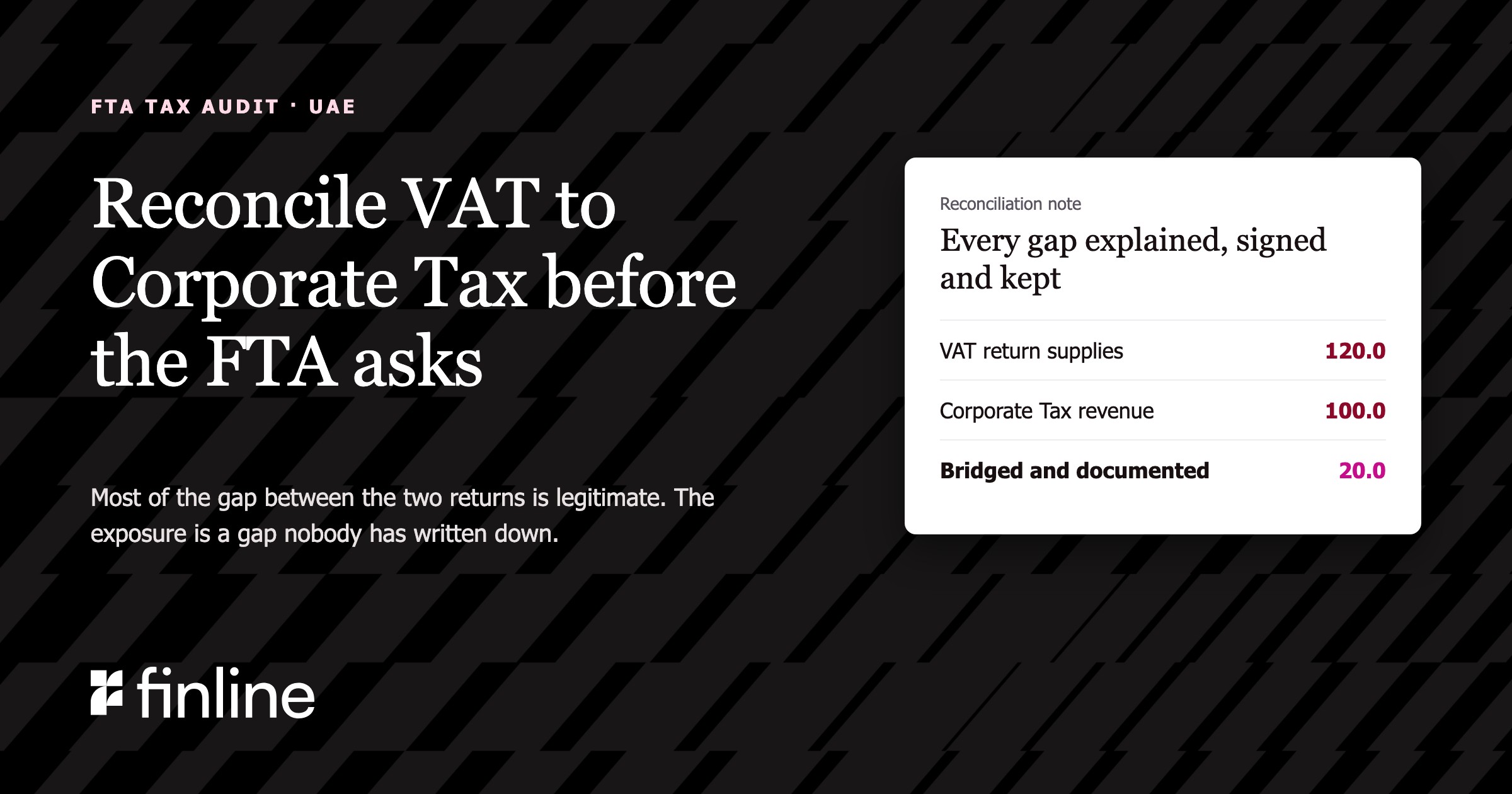
No FTA publication describes a programme that matches VAT returns to Corporate Tax returns, but Alvarez & Marsal expects the question to be asked. In a hypothetical with AED 120 million of VAT supplies against AED 100 million of Corporate Tax revenue, the firm wrote that "the FTA will likely flag this discrepancy and request an explanation". [7]
Field enforcement is rising too, though these are VAT and excise market inspections rather than tax audits: about 93,000 field inspection visits in 2024, 176,000 in 2025 and 103,680 in the first half of 2026. [8][9][10]
Why VAT supplies and Corporate Tax revenue legitimately differ
The bridge may need a line for each of these.
- VAT is due on the date of supply, broadly the earlier of invoice or payment (with extra triggers for periodic contracts), while Corporate Tax follows accounting revenue. Advances reach the VAT return first; revenue recognised over time can reach the accounts first. [11]
- Deemed supplies carry VAT without creating revenue: assets given away, private use where input tax was recovered, and assets held at deregistration, subject to narrow exceptions. [11]
- A cost paid on a customer's behalf and recovered at cost is a disbursement, outside VAT; one incurred as principal and recharged follows the main supply. [12]
- Zero-rated and exempt supplies are revenue outside Box 1; out-of-scope supplies, such as those made outside the UAE, are revenue with no box. Reverse charge and imports inflate Box 8 without being revenue, so the bridge runs to Boxes 1, 4 and 5, never Box 8. [11][2]
- Selling a vehicle or equipment is a taxable supply in the VAT return, while the accounts show only the gain or loss on disposal.
- Bridges often also carry foreign exchange differences, cross-period credit notes, group eliminations and foreign branch income.
Illustrative bridge. The amounts are invented to show how the lines combine.
- Revenue per Corporate Tax return: AED 100.0 million. Income statement revenue.
- Add: advances received and invoices issued before revenue is recognised: AED 17.0 million. VAT due at invoice or payment, if earlier.
- Add: sale of vehicles and equipment: AED 4.5 million. Taxable supply; accounts show only the gain or loss.
- Add: deemed supplies: AED 0.5 million. VAT is due without revenue.
- Less: supplies made outside the UAE: AED (2.0) million. Revenue with no VAT box.
- Supplies reported in VAT returns (Boxes 1, 4 and 5): AED 120.0 million. Ties to the filed returns.
What a reconciliation note should contain
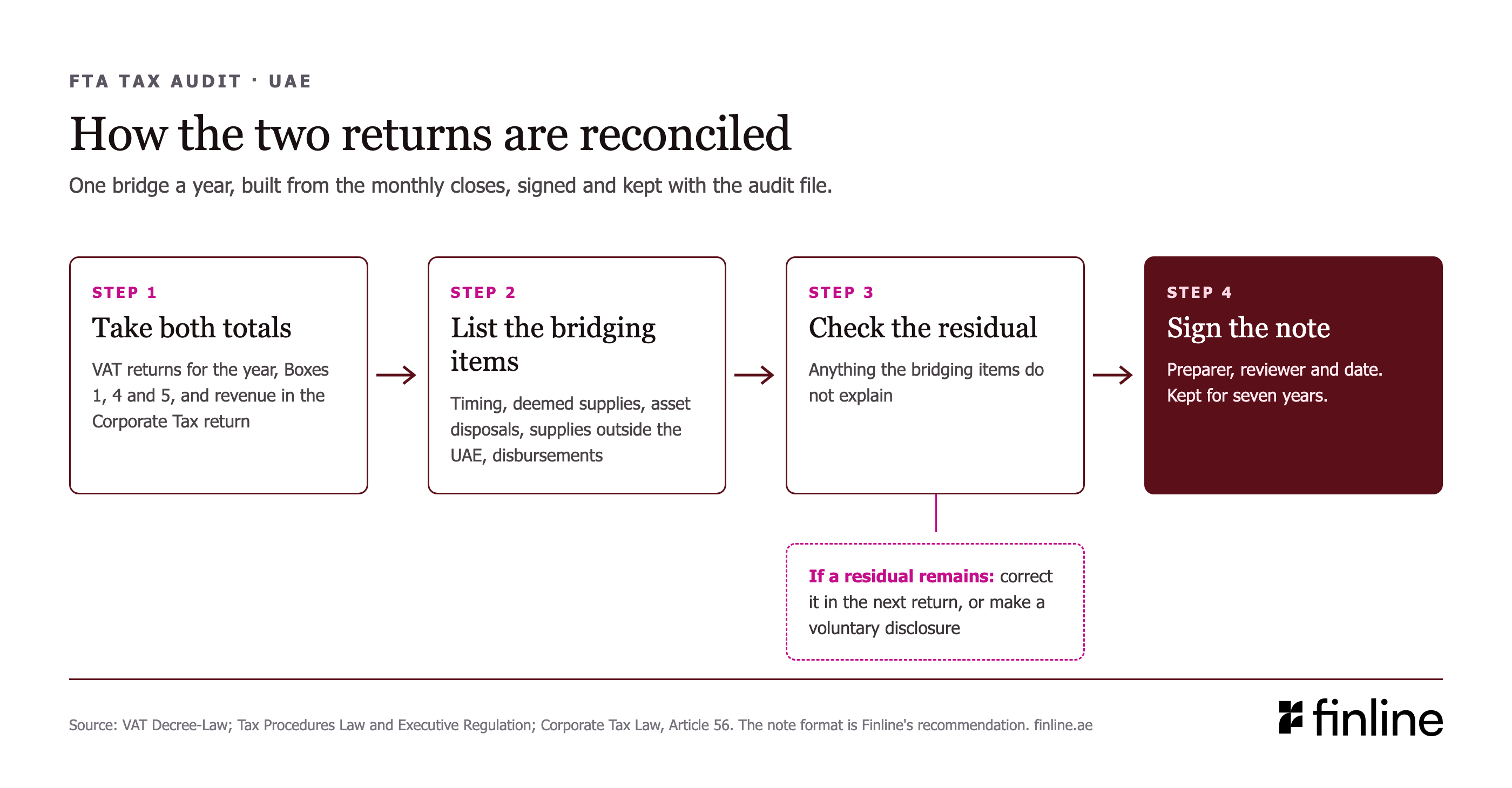
A bridge becomes audit evidence once written up and signed. The FTA publishes no template; this minimum is Finline's recommendation:
- the period covered and the two totals compared, naming the VAT boxes and the revenue figure in the Corporate Tax return;
- each bridging item, with its amount, the legal or accounting reason, and a pointer to the ledger accounts or invoice list behind it;
- any unexplained residual and the action taken: next-return correction where the error changes no tax, otherwise voluntary disclosure; [13]
- preparer, reviewer and date.
Prepare it each year ahead of the Corporate Tax filing date for your year-end, and refresh it whenever a VAT return is corrected.
The FTA will hold your VAT position invoice by invoice. The reconciliation is how you show it adds up.

Why e-invoicing makes the reconciliation harder to skip
E-invoicing moves the VAT side of the bridge from a return total to invoice-level data. Under the Ministry of Finance guidelines, the supplier's accredited service provider (ASP) delivers each invoice and, in parallel, reports its tax data to the FTA; the buyer's ASP reports again on validation. The guidelines also list analysing e-invoice data for tax audits and fraud detection among the FTA's roles. [5][6]
Every e-invoice carries a mandatory tax category per transaction (standard rated, zero rated, exempt, out of scope, reverse charge or margin scheme) and a VAT amount in AED per line. Exempt and out-of-scope supplies move onto e-invoices too, so supplies with no VAT box will also be reported. [5]
The published rules give no way to edit an issued e-invoice: errors, cancellations and price reductions are fixed with an electronic credit note, or an additional invoice where tax was under-charged, and both are reported. A wrong tax category on an issued invoice cannot be put right with a month-end journal alone: the FTA would hold the original and the correction as separate records. [14][11][15]
Cabinet Decision 106 of 2025 penalises e-invoicing process failures, such as a late provider appointment or late invoices and credit notes. It has no line for wrong tax data. That is more likely to fall under the general tax penalties, such as those for an incorrect return. [16][17]
Nothing published says which VAT return fields will be pre-populated, or links e-invoice data to the Corporate Tax return. Until that changes, the prudent assumption is that every VAT figure filed can be rebuilt from the invoices behind it. [6]
Under the current implementation decision, businesses with revenue of AED 50 million or more appoint a provider by 30 October 2026 and go live on 1 January 2027; those below appoint by 31 March 2027 and go live on 1 July 2027. Ministerial Decision 197 of 2026 changed other system rules from 1 October 2026, not these dates. The first step for either group is choosing an ASP. [18][19][20]
Qualifying free zone person: the de minimis test needs revenue tagged at source
Under Ministerial Decision 229 of 2025, a qualifying free zone person keeps its status only while non-qualifying revenue stays within 5% of total revenue or AED 5 million, whichever is lower. [21]
Total revenue for the test excludes revenue taxed at 9% under separate rules: permanent establishments, certain free zone real estate and non-qualifying intellectual property. Non-qualifying revenue is the sum of revenue from excluded activities, from non-qualifying activities with non-free-zone persons, and from free zone persons that are not the beneficial recipient. [3]
For example, at AED 40 million of total revenue the cap is AED 2 million, so AED 2.3 million of non-qualifying revenue fails. Failing the test ends the status from the start of that tax period and for the four tax periods after it, five in all. Every qualifying free zone person also needs audited financial statements, whatever its revenue, for tax periods starting on or after 1 January 2025. [21][22]
The test needs tags at source: each counterparty marked as free zone person and beneficial recipient or not, each revenue line by activity, and separately taxed income split out.
Before an FTA tax audit: UAE look-back, notice, records and penalties
An audit or assessment can generally reach back five years from the end of the tax period, or fifteen for evasion or failure to register. It runs longer where an audit was notified within the five years or a voluntary disclosure or refund claim was filed in year five; the refund-linked extension is new from 1 January 2026. Notified tax and penalties never lapse, and refunds must generally be claimed within five years. [13]
Notice is at least 10 business days. The FTA may enter without it only on serious grounds to suspect evasion or obstruction, with the Director General's prior written consent. Results follow within 10 business days of the audit ending. [13][1]
VAT records are kept five years after the tax period, plus four during an audit or dispute, one after a year-five disclosure and, under the April 2026 amendments to the Executive Regulation, two while a refund claim is undecided. Corporate Tax records are kept seven years, and Finline recommends the same for everything behind revenue. [1][23][4]
Under the tax penalty schedule as amended from 14 April 2026, failing to keep the required records costs AED 10,000, or AED 20,000 for a repeat within 24 months. Failing to provide records in Arabic when asked costs AED 5,000, and failing to facilitate the tax auditor AED 20,000. [17]
The master data that turns the reconciliation into an hour's work
The bridge is quick when one system of record owns the chart of accounts, ledger and controls, and applies VAT treatment at posting rather than by hand at month-end. If each monthly close ties the VAT control accounts to the VAT reported for the month, the annual bridge summarises twelve reconciliations.
The vendor master comes first. It needs fields most ERPs don't carry by default: verification tier, verification date, reviewer, conclusion, risk-flag explanation, bank confirmation date and next refresh date. Once those exist, the ERP can enforce them. A vendor with an overdue refresh is blocked from posting or payment, and the exception is routed to a named person. Those fields also keep the supplier-verification file behind each input tax claim current.
Customer and tax fields follow from the bridge: tax registration number (TRN), tax treatment code, emirate of supply for the Box 1 split, free zone flag, beneficial-recipient flag, activity tag (qualifying, excluded or non-qualifying), and a link from each advance to its final invoice. With those on every record, each bridging line becomes a filtered report.
That is the basis of how Finline runs VAT and Corporate Tax off one ledger, end to end or alongside a business's own team, ERP and auditor.
Sources
1. Cabinet Decision No. 74 of 2023 on the Executive Regulation of Federal Decree-Law No. 28 of 2022 on Tax Procedures: Federal Tax Authority (10 July 2023). https://tax.gov.ae/Datafolder/Files/Legislation/Cabinet%20Decision%20No.%2074%20of%202023%20on%20Executive%20Regulation%20of%20Federal%20Decree-Law%20No.%2028%20of%202022%20on%20Tax%20Procedures%20-%20For%20Publishing.pdf
2. VAT Returns form, VAT 201, Taxpayer User Manual: Federal Tax Authority (October 2022). https://tax.gov.ae/DownloadOpenTextFile?fileUrl=en%2FVAT_VAT_Guides%2FVAT_Returns_form%2FProcess_the_VAT_201_returns_form_EN.pdf
3. Corporate Tax Guide, Tax Returns (CTGTXR1): Federal Tax Authority (November 2024). https://tax.gov.ae/Datafolder/Files/Guides/CT/CT-Returns-EN-11-11-2024.pdf
4. Federal Decree-Law No. 47 of 2022 on the Taxation of Corporations and Businesses: Ministry of Finance (December 2022). https://mof.gov.ae/wp-content/uploads/2022/12/Federal-Decree-Law-No.-47-of-2022-EN.pdf
5. UAE Electronic Invoicing Guidelines, Version 1.1: Ministry of Finance (1 June 2026). https://mof.gov.ae/wp-content/uploads/2026/06/UAE-Electronic-Invoicing-Guidelines_V-1.1-01June2026.pdf
6. eInvoicing: Ministry of Finance (last updated 21 October 2026). https://mof.gov.ae/en/about-us/initiatives/einvoicing/
7. Middle East Tax Alert, UAE: From VAT to Corporate Tax, How FTA's Risk-Based Audits Will Shape Compliance in 2026: Alvarez & Marsal, via Mondaq (22 December 2025). https://www.mondaq.com/tax-authorities/1725038/middle-east-tax-alert-%7C-uae-%7C-from-vat-to-corporate-tax-how-fta-s-risk-based-audits-will-shape-compliance-in-2026
8. New digital technologies improve tax compliance as FTA increases inspection visits to ninety-three thousand in 2024: Federal Tax Authority (19 February 2025). https://tax.gov.ae/en/media.centre/news/new.digital.technologies.improve.tax.compliance.as.fta.increases.inspection.visits.to.nighty.three.thousand.in.2024.a.yearonyear.increase.of.135.aspx
9. Federal Tax Authority Conducted 176,000 Market Inspection Visits in 2025, Up 89% Year-on-Year: Federal Tax Authority (7 April 2026). https://tax.gov.ae/en/media.centre/news/federal.tax.authority.conducted.176000.market.inspection.visits.in.2025.up.89.yearonyear.aspx
10. FTA Conducts 103,680 Inspection Visits in Six Months, Up 21%: Federal Tax Authority (11 August 2026). https://tax.gov.ae/en/media.centre/news/fta.conducts.103680.inspection.visits.in.six.months.up.21.aed.174.million.in.tax.liabilities.and.administrative.penalties.associated.with.8.5.million.noncompliant.excise.products.seized.across.uae.markets.during.first.half.of.2026.aspx
11. Federal Decree-Law No. 8 of 2017 on Value Added Tax and amendments: Federal Tax Authority (2025). https://tax.gov.ae/Datafolder/Files/Legislation/2025/Federal-Decree-Law-No-8-of-2017-and-amendments.pdf
12. VAT Public Clarification VATP013, Disbursements and Reimbursements: Federal Tax Authority (2019). https://tax.gov.ae/DataFolder/Files/Pdf/VATP013%20-%20Disbursements%20and%20Reimbursements.pdf
13. Federal Decree-Law No. 28 of 2022 on Tax Procedures, consolidated with Decree-Laws No. 17 of 2024 and No. 17 of 2025: Federal Tax Authority (3 December 2025). https://tax.gov.ae/Datafolder/Files/Legislation/2025/Federal%20Decree-Law%20No.%2028%20of%202022%20-%20publishing%2003%2012%202025.pdf
14. Ministerial Decision No. 243 of 2025 on the Electronic Invoicing System: Ministry of Finance (September 2025). https://mof.gov.ae/wp-content/uploads/2025/09/Ministerial-Decision-no.-243-of-2025-on-the-Electronic-Invoicing-System.pdf
15. VAT Public Clarification VATP046, Amendments to the VAT Decree-Law (Federal Decree-Law No. 16 of 2024 and No. 16 of 2025): Federal Tax Authority (September 2026). https://tax.gov.ae/Datafolder/Files/Guides/VAT/PublicClarifications/VATP046%20-%20Amendments%20to%20VAT%20Decree-Law%20-%2009%202026.pdf
16. Cabinet Decision No. 106 of 2025 on Violations and Administrative Penalties for the Electronic Invoicing System: Ministry of Finance (December 2025). https://mof.gov.ae/wp-content/uploads/2025/12/Cabinet-Decision-Violations-and-Penalties-eInvoicing-final-version-en-8.12.25.pdf
17. Cabinet Decision No. 40 of 2017 on Administrative Penalties for Violations of Tax Laws, as amended including Cabinet Decision No. 129 of 2025: Ministry of Finance (November 2025). https://mof.gov.ae/wp-content/uploads/2025/11/Cabinet-Decision-No.-40-of-2017-and-its-amendments-v14.11.25.pdf
18. Ministerial Decision No. 244 of 2025 on the Implementation of the Electronic Invoicing System: Ministry of Finance (September 2025). https://mof.gov.ae/wp-content/uploads/2025/09/Ministerial-Decision-No.-244-of-2025-on-the-Implementation-of-the-Electronic-Invoicing-System.pdf
19. Ministerial Resolution No. 66 of 2026 Amending Certain Provisions of Ministerial Resolution No. 244 of 2025: Ministry of Finance (May 2026). https://mof.gov.ae/wp-content/uploads/2026/05/Ministerial-Resolution-No.-66-of-2026-Amending-Certain-Provisions-of-Ministerial-Resolution-No.-244-of-2025-Regarding-the-Implementation-of-the-Electronic-Invoicing-System-En-20260514.pdf
20. Ministry of Finance amends electronic invoicing regulations to ease the burden on businesses: Ministry of Finance (19 October 2026). https://mof.gov.ae/en/news/ministry-of-finance-amends-electronic-invoicing-regulations-to-ease-the-burden-on-businesses/
21. Ministerial Decision No. 229 of 2025 Regarding Qualifying Activities and Excluded Activities: Ministry of Finance (28 August 2025). https://mof.gov.ae/wp-content/uploads/2025/09/EN-Ministerial-Decision-No.-229-of-2025-Regarding-Qualifying-Activities-and-Excluded-Activities.pdf
22. Ministerial Decision No. 84 of 2025 on Audited Financial Statements: Ministry of Finance (25 March 2025). https://mof.gov.ae/wp-content/uploads/2025/04/Ministerial-Decision-No.-84-of-2025-on-Audited-Financial-Statements.pdf
23. Ministry of Finance announces amendments to Tax Procedures Executive Regulations effective April 2026: Ministry of Finance (1 April 2026). https://mof.gov.ae/en/news/ministry-of-finance-announces-amendments-to-tax-procedures-executive-regulations-effective-april-2026/
Check your VAT returns against your Corporate Tax return before the FTA asks
A senior finance specialist will bridge your filed VAT returns to the revenue in your Corporate Tax return, document each reconciling item and flag any residual that needs correcting.
Frequently asked questions
VAT is charged on the date of supply, which can be the invoice or payment date, while Corporate Tax follows accounting revenue. Deemed supplies and asset disposals appear in the VAT return but not in revenue, and supplies made outside the UAE are revenue with no VAT box. Reverse-charge and import amounts belong in neither comparison, so reconcile revenue to Boxes 1, 4 and 5.
Generally five years from the end of the tax period, under Article 46 of the Tax Procedures Law. The period is fifteen years for tax evasion or failure to register, and longer where an audit was notified within the five years or a voluntary disclosure or refund claim was filed in year five. Tax and penalties already notified never lapse.
Keep Corporate Tax records for seven years after the end of the tax period, and VAT records for at least five years after the end of the tax period they relate to. Mainland companies must also keep their accounting registers at their head office for at least five years under the Commercial Companies Law.
That means the ledgers and the documents behind them: invoices issued and received, credit notes, contracts, bank statements, payroll records and the working papers for each return. Failing to keep the required records carries a penalty of AED 10,000 for a first violation and AED 20,000 for a repeat within 24 months.
There is no statutory checklist. The FTA may inspect documents, electronic records and the accounting system itself, and ask for information in the form and within the period it sets. Keep VAT records at least five years after the tax period and Corporate Tax records seven years, and be ready to provide them in Arabic on request. From 14 April 2026, failing to keep the required records costs AED 10,000 per violation, or AED 20,000 for a repeat within 24 months.
Non-qualifying revenue must not exceed 5% of total revenue or AED 5 million, whichever is lower, under Ministerial Decision 229 of 2025. Total revenue for the test excludes income taxed at 9% under separate rules, such as permanent establishment income and certain free zone real estate income. A business that fails loses qualifying status from the start of that tax period and for the following four.
At least 10 business days, under the Tax Procedures Law. The FTA may enter without notice only where it has serious grounds to suspect evasion or obstruction, and only with the Director General's prior written consent. Results are notified within 10 business days of the audit ending.
No. Since 1 January 2026, a business that accounts for VAT under the reverse charge no longer issues a self-invoice. It keeps the supporting documents for the transaction that the Executive Regulation specifies.

